Natural Selection to Neo-Darwinism: Societal Confrontations of Evolutionary Biology

By Chris La Placa

The theory of natural selection first broke ground in the mid-Victorian era, describing the process by which individuals grapple with environmental selection pressures that will ultimately predict the taxonomic composition of the following generation. It was not until the “Modern Synthesis” of the 1930s and 1940s that these theories were adequately supplemented with Mendelian and population genetics, enriching their validity and popular reception in the academic realm. However, the implications of these research advancements were not always greeted with equal societal enthusiasm. Examination of primary and secondary sources from both the Victorian and the “Neo-Darwinism” eras seems to suggest that while the two eras endured reasonably similar amounts of scrutiny, the sources of these responses were not always consistent. This is to say that the public concern with evolutionary biology was initially rooted largely in scientific skepticism and defense of religious traditions, not immediately concerned with the social implications of science until the crude interpretation of the “Modern Synthesis” made an explicit attack on racial minority groups.

Charles Darwin’s On the Origin of Species by Means of Natural Selection (1859), despite its eventual contributions to evolutionary biology, is characterized by a speculative, theoretical voice that was widely considered unsound and provisional due to its absence of a reliable scientific framework. Its proposal of a non-Creationist emergence of modern humans nonetheless shocked the public both scientifically and religiously, warranting fervid objections on the grounds of genetics, geology, and creed. In an 1867 review of Origin, Fleeming Jenkin introduced the “swamping” argument, a view of adaptation and inheritance discounting the potential of genes in lower frequencies to be expressed in large populations where such phenotypes are absent; this idea neglected to account for the slow and gradual process of evolution proposed by Darwin (himself influenced by Lyell). Unchallenged by research in population genetics, which would later disprove Jenkin, this claim’s logical deficiencies fueled the popular skepticism of the theory of natural selection on a genetic basis (Aronova).

Similarly, in 1862, William Thompson (later Lord Kelvin) employed thermal gradients in attempting to establish the age of the earth, argued in Origin to be conducive to billions of years of organismal adaptations — Thompson’s estimation of a maximum age of 100 million years deemed natural selection’s production of anatomically modern Homo sapiens impossible. However, this rebuttal was also flawed in its ignorance of the mechanics of solar convection, yielding a much younger age of the earth than truly accurate (Aronova). Finally, religious discordance grew abundant due to challenges to Creationism. Several responses archived by the Darwin Correspondence Project represent an overarching public disapproval of late-Victorian scientific publications, all of which undermined previous conceptions that human origins were divine rather than evolved from a lineage of nonhuman ancestors. While this discourse was productive in integrating evolutionary science into the public sphere, the era’s religious tradition prevented science from persuading preconceived theories pertaining to taxonomic variance. Scientific and religious objections to Darwin’s On the Origin of Species by Means of Natural Selection were rampant in the late 19th century and beyond; however, these arguments were primarily those of members of majority groups not targeted by the social implications of natural selection’s most contentious question: man’s place in nature.

Darwin’s Descent of Man, and Selection in Relation to Sex (1871) addresses this inquisition — the origins of human nature and behavioral ecology — through its elaboration on the theory of sexual selection, previously described as depending “not on a struggle for existence, but on a struggle between the males for possession of the females; the result is not death to the unsuccessful competitor, but few or no offspring” (Origin 88). Sexual selection attempts to differentiate between opposing characteristics of the sexes that may be advantageous in ensuring maximum reproductive success, raising offspring to their own “alpha,” or age at first reproductive event. This theory describes men as releasers of physical and intellectual energy, physiologically katabolic, large-brained, intelligent, independent, eager, courageous, and passionate beings. Contrarily, women are cast as storers/conservers of energy, physiologically anabolic, nurturing, altruistic, constant, stable, commonsensical, and intuitive creatures. This bipolar model of gender roles, while accepted in the scientific realm, was socially detrimental and sizably criticized by members of a growing feminist community emerging not until the early 20th century.

The vanguard of this liberal sentiment was Charlotte Perkins Gilman, niece of abolition novelist Harriet Beecher Stowe and author of The Man-Made World and Our Androcentric Culture (1911). Warranted by the socially-ignorant conclusions of sexual selection theorists, Gilman’s work confronted the dyadic gender roles and natural order proposed by Darwin, arguing that by seeking economic independence from men, women would be successful in restoring a sense of balance between the sexes. This attention to the negative consequences of scientific theory pertinent to human nature was scarcely, if at all, publicized until over five decades after Charles Darwin’s first major literary contribution. Dissimilarly, challenges to the scientific merit and ecclesiastical implications of the theory of natural selection surfaced nearly instantly. While it is true that the explicit controversy incited by Darwin’s work was the scientific origin of species, the biological parameters of gender inequality in society were not confronted with adequate zeal. This was a prominent characteristic of evolutionary science in the late-Victorian era — its implicit societal shortcomings were condoned while false scientific skepticism penetrated and permeated the public dialogue.

While his earliest literature transformed Darwin into a public figure nearly overnight, his esteemed scientific reputation was not void of social defamation. The 1930s and 1940s witnessed the genesis of the “Modern Synthesis,” unifying Darwinian natural selection with Mendelian and population genetics, and birthing a Neo-Darwinist view on human origins which accounted for heritability and adaptation. The genetic basis of so-called “new biology” was scientifically sound, yet grossly abused in its vast applications to non-hereditary organismal features. This ignorance can be attributed to research in eugenics, a genetic concept rooted in selective sheep breeding at Robert Bakewell’s farm in 18th century Leicestershire. His striking results inspired works such as Francis Galton’s influential Hereditary Genius (1868), which presented evidence for inheritance of mental traits among a human population. This research spiraled into a dark form of social control in Victorian England, in which it was believed that artificial selection should be used as a method for preservation of the status quo and hierarchy, breeding human beings like cattle based on physical and mental capability. Eugenics was further justified by the popular desire to remedy the perceived collapse of human society as a result of industrialization. Darwin’s ignorant claims regarding the laws governing heredity and variation did nothing to ameliorate the calamity of eugenics. Furthermore, a unanimous public displeasure with eugenics was invisible due to its benefits to a majority of individuals affected by its processes. This sentiment does not parallel that of those reacting to speculative biology of the 19th century, presumably due to the implementation of convincing genetic research into 20th century science, despite its misuse.

The credibility of eugenics did decline as a result of several factors, including the disadvantages of human subjects research, increasing knowledge and recognition of the multidimensionality of heredity, and the rise of Nazism in 1930s Germany. However, the crude interpretation of Mendelian theory in its application to non-hereditary characteristics persisted with the publication of E.O. Wilson’s Sociobiology (1975), a well-intentioned text seeking to unify social sciences with the physical sciences. Wilson and many others saw the application of biological principles in explaining social phenomena to be the logical continuation of the Neo-Darwinist trajectory, himself writing that “sociology should be reshaped in the same way that taxonomy and ecology…have been reshaped entirely during the past forty years by integration into the ‘Modern Synthesis’” (Wilson 4). While this movement optimistically aimed to synthesize scholarship from interdisciplinary origins, undertones of biological and genetic determinism ultimately tainted this goal. Wilson expresses that “the individual organism is only the ‘vehicle of the genes,’ part of an elaborate device to preserve and spread them[selves]” (Wilson 3). Similarly, Richard Dawkins wrote in his 1976 book The Selfish Gene that “we are survival machines — robot vehicles blindly programmed to preserve the selfish molecules known as genes” (Dawkins). The unavoidably oppressive tones of these works seem to rob humans of their individuality and agency, assigning importance only to the perpetuation of genotypes and respective lineages. Regardless of its liberal intentions, the concept of sociobiology is inherently racist as it assigns normalcy to the primary population or culture in question, effectively othering all those who do not conform to this standard; like to eugenics, it employs Mendelian and population genetics in considering learned, rather than inherited qualities. Lacking a holistic view of sociality, sociobiology’s attempt to amalgamate biological and social sciences was a failure.

Unlike the delayed and relatively mild public response to the social implications of sexual selection, eugenics and sociobiology were confronted by ardent activism originating in the 1960s, characterized by the second wave of feminism, the rise of environmental agencies, anti-Vietnam war protests, and civil rights movements. Organizations such as the Union of Concerned Scientists assembled to protest the negative direction of science in the mid-late 20th century. This group exemplified liberal scientific activism, criticizing neither science nor government, but aiming to apply the vast aptitude of researchers in addressing societal epidemics such as poverty, malnourishment, urban decay, and environmental pollution (Francis Low, UCS Member). The Science for the People’s sociobiology study group, emerging in 1968, sought to combat the conservative politics of biological reductionism with the liberal ideal of “universalism” — this concept implies that individuals are afforded the same basic rights and have national and global responsibilities, rather than ethnic, political, or otherwise stratigraphic obligations. An increasingly multiculturalist agenda in the humanities was instrumental in ensuring the inclusion and representation of diverse and disenfranchised groups previously invisible in the racially-charged atmosphere produced by the works of Francis Galton and E.O. Wilson.

This underlying commitment to rejecting racism conjured up by advancements in evolutionary biology was a unique characteristic of the Neo-Darwinist era, unseen during past episodes of turmoil between society and the sciences. As understandings of the politics of human nature increased, so did the unifying climate of the Western world. Reliable scientific research emerged, describing that very few genetic nuances differentiate members of the same family; however, these individuals remain behaviorally and socially unique from one another. Similar ideas successfully denounced notions that behavior is heritable, that race has cognitive distinctions, and that certain cultures cannot escape imminent domination. The public response to the “Modern Synthesis” resulted in several fruitful modifications to previously acute tensions in society. This outcome is the product of criticism more focused on the subtle implications of biology and genetics, rather than the merit of the science itself.

Speculative 19th century evolutionary theory and Neo-Darwinism were similar iterations of biology in their ignition of societal retaliation in response to their use and misuse of scientific information. However, the foundations and magnitude of these retaliations were what characterized these periods. The response to Darwin’s early publications was largely critical of the absent scientific framework of his theories, and secondarily protective of the authenticity of divine origins of human beings. Not until half a century later did the public address gender inequality associated with the theory of sexual selection through the genesis of early feminist thought. Inversely, the “Modern Synthesis” saw itself under attack as early as the 1930s, as people began to discontinue their beliefs in eugenics. The analytical sentiment towards the notion of biological determinism holds momentum to this day, 2017 being a year in which eugenic thought has certainly resurfaced in the United States. The issues raised by scientific thought in the Victorian era certainly reemerged with the advent of Neo-Darwinism, and will likely persist due to an ever-changing concept of “human nature.”


Works Cited

Aronova, Elena. “Darwinian Revolution.” Fall 2016. Department of History, University of California, Santa Barbara.

Darwin, Charles. On the Origin of Species by Means of Natural Selection, Or, the preservation of Favoured Races in the Struggle for Life. J. Murray, 1859.

Darwin, Charles. The Descent of Man, and Selection in relation to Sex. J. Murray, 1871.

Dawkins, Richard. The Selfish Gene. Oxford University Press, 1989.

Galton, Francis. Hereditary Genius: An Inquiry into Its Laws and Consequences. Watts & Co, 1892.

Gilman, Charlotte P. The Man-Made World: Or, Our Androcentric Culture. Source Book Press, 1970.

Wilson, Edward O. Sociobiology: The New Synthesis. Belknap Press of Harvard University Press, 2000.

A World I Never Made: Dualism, Violence, and Sexuality in the Novels George Washington Goméz and The Autobiography of a Brown Buffalo

By Francisco Olvera

Racial identity (and its formation) within the United States is an ongoing conversational theme, and given our recent election, a crucial one. If one looks at the history of the United States, it is apparent that its culture and society, at large, produces feelings of inferiority within people of color and other marginalized groups. In contribution to this conversation about the role U.S. society plays in the formation of racial identity, this paper conducts a close reading of two novels, written by Chicano authors, and structured as first-person narratives: George Washington Gomez by Américo Paredes and The Autobiography of a Brown Buffalo by Oscar Zeta Acosta. In doing so, it seeks to answer the following questions: How do fictional Chicano males imagine their identity within a hegemonic white society? Furthermore, how does this hegemonic white society, built on years of racial hierarchy and division predicated on policies and practices of exclusion, shape and form Chicano masculinity? And finally, to bring it all together, how do these Chicano novelists portray the complexity of Chicano masculinity as reflective of a society and culture that denies their sense of identity and citizenship? The answer to these questions can be seen in the actions and reactions of the fictional characters within the novels. Although fictional, these characters are still able to illustrate, through their lives, the effects of a racist society. This is seen in intimate ways through questions of identity that revolve around fragmented episodes of sexual intimacy and tension, as well as acts of violence. Identity for the Chicano male thus becomes a place of fluid complexity. It is in this space where one comes to realize that we are not all just human beings attempting to survive the toils of daily life. Rather, some of us have histories stained by oppression; histories that still haunt and affect us today. So, while current reactionary critics on the political right make cases about the “vile” and “regressive” role that identity politics play in the United States, they lack a complex view of history that puts the onus of “identity politics” on policies and practices orchestrated by a white hegemonic state.

Practices of alienation and exclusion implemented by the United States directly affect people of color by limiting their social and economic opportunities. Furthermore, these practices construct visible and invisible divides in society which in turn create a racial hierarchy that privileges some at the expense of others. The effects of these divides appear in the areas of education, health, and freedom from imprisonment. The study of these specific areas, however, fails to expose and reveal the unique and individual psychological turmoil within racial subjects who inhabit and exist in a society of exclusion. Fiction allows for a more thorough examination into the turmoil experienced by these individuals. Through the close reading of George Washington Goméz by Américo Paredes, and The Autobiography of a Brown Buffalo by Oscar Zeta Acosta, this study will examine how these novels expose fragmented identities created by a culture of racial hierarchy and division, and how this fragmentation reflects itself through a complex Chicano masculinity in the central characters. This complex negotiation of masculinity appears in these novels in the areas of violence and sexuality.

One way to understand the relationship between a culture of racial hierarchy and masculinity is by understanding that this culture, through its very structure, renders Chicano identity inferior. Masculinity is an area in which fragmentation occurs if coupled with structural racial hierarchy. A fragmented Chicano masculinity can be defined as a reactionary way of being due to feelings of inferiority, and these reactions manifest in the treatment of women as inferiors in order to create within a façade of strength and power. Gloria Anzaldúa, writing about being a “macho” (a man), states, “for men like my father, being a ‘macho’ meant being strong enough to protect and support my mother and us, yet being able to show love” (Anzaldúa 105). Here Anzaldúa provides a positive account of what being a “macho” can mean and presents a figure of both strength and love. However, she later goes on to juxtapose this figure with her modern conception of a “macho,” one whose “machismo [masculine pride] is an adaptation to oppression and poverty and low self-esteem” and later adds that “in the Gringo world [which is to say the American world], the Chicano suffers from excessive humility and self-effacement, shame of self and self-deprecation” [emphasis added] (Anzaldúa 105). These factors fragment the sense and performance of masculinity in Chicanos, and thus, for Anzaldúa, “the loss of a sense of dignity and respect in the macho breeds a false sense of machismo which leads him to put down women and even to brutalize them” (105). This “false sense of machismo” creates a complex Chicano masculinity under the much larger Chicano identity.

A better way to understand this complex masculinity is to apply the term “double-consciousness” to the Chicano male experience. W.E.B. Du Bois states, “the Negro is a sort of seventh son, born with a veil, and gifted with second-sight in this American world,—a world which yields him no true self-consciousness but only lets him see himself through the revelation of the other world” (5). Like Anzaldúa, Du Bois understands the power the “American world” holds over shaping and defining the identity (a “consciousness”) of racial subjects. The other world, the “American world” only allows the Chicano male subject to see himself in the light of inferiority. This application of “double-consciousness” to the Chicano experience is helpful in order to understand the dichotomy between “normative” American identity (whiteness) and that of racial subjects, and how this dichotomy plays an important role in the shaping of racial identity and its subparts.

George Washington Goméz, a bildungsroman, begins with the birth of George Washington Goméz (also referred to as Guálinto), “born a foreigner on his native land…fated to a life controlled by others,” and follows him as he navigates the hostile early 20th century in the border state of Texas. Symbolically, this location places Guálinto between two worlds which will collide throughout his life: the American and the Mexican.  Masculinity, as a component of Chicano identity, appears and manifests itself in complex and fragmented ways. One way in which it does so is through violence. Violence in the novel is either absorbed by Guálinto and shapes him, or appears in the ways Guálinto expresses himself as a racial subject with a history of neglect. In the novel’s beginning Guálinto’s father is murdered by Texas Rangers, and on his deathbed asks his brother Feliciano (Guálinto’s uncle) not to tell Guálinto how he died for he does not want his son to feel hate (21). Feliciano, troubled by this, remarks how “it [will] be very hard to keep such a terrible truth from this male child” (Paredes 31). The early death of his father overshadows Guálinto as he grows up; for his father, a figure of masculinity, has been taken away by the same dominant force that years before took his native land (the proto-threat to Chicano identity). By denying Guálinto an important symbol of masculinity, the racial system of hierarchy and division which he inhabits begins to split and fragment his personal evolving identity.

Although Guálinto does not learn about his father’s death until much later in the novel, the hyper-violent ways in which he expresses himself in his youth reveal a subconscious understanding of the event which denied him a masculine figure crucial to his identity. An example of this appears when Guálinto begins to ask his uncle questions about what his father was like and what killed him. Feliciano lies and tells him he died of a heart attack, but he also informs him that his father was a gentleman (Paredes 101). Eventually, the talk leads to Feliciano revealing his personal antagonisms towards the “gringos” and he gives Guálinto a brief history of his people’s disenfranchisement in the hands of the “gringo” (Paredes 102). To all of this Guálinto responds, “‘Just wait till I grow up! Just wait till I’m a man! I’ll get our land back. I’ll be like Gregorio Cortez and Cheno Cortinas and all of them.’ He pulled out an imaginary gun. ‘Shoot them down like dogs. Ping, ping…I’ll kill all the Gringos and the rinches too, and drive them away from here” [emphasis added] (Paredes 103). Guálinto conflates manhood, and thus masculinity, with murder. He believes that one’s manhood grows through violence intended to affirm an illusionary sense of strength and power. Of course, one could argue that this is just a child with a big imagination, but to do so would undermine the violent state within which Guálinto lives and exists. His hyper-violent thoughts do not reflect a childhood imagination; rather, they reflect the world that has taken away his father and thus they affirm a brokenness which finds expression in false and vile conceptions of masculinity. They are simultaneously expressions of vulnerability and aggression. Double-consciousness returns here as an indication of what the U.S. dominant white world has placed upon Guálinto’s subjectivity: a history of violence which he then uses as his own vile defense.

The imposition of a racialized consciousness also affects Guálinto’s masculinity in the complexity of sexual tensions and desires. The heteronormative sexuality presented in these novels implies sexual relations and thus sexual reproduction. Matters of sexual reproduction become important when one considers how people are categorized as racial subjects, which is in part through their physical appearance. This is evident in an event that occurs towards the beginning of the novel where Gualinto is perceived as a white child due to his appearance. A Texas Ranger (a rinche) is aggressive towards Guálinto’s uncle and mother, asking them “Where’d [they got] that white child?…chico americano” (Paredes 32). Here, racial features are associated with national identity.

Questions surrounding sexual reproduction become more prominent as Guálinto grows up. After being involved in a knife fight in which he comes out victorious, people at a party who witnessed his fight invite him over. What follows is a hyperbolic celebration of his affirmed “masculinity.” The party he enters is a quinceañera, an important festivity in Mexican culture marking the passage from childhood to womanhood. In a way, this celebration acts as a mirror to his own passage into manhood. These events meld together and represent a larger rite of passage into adulthood for both the girl and boy, but this melding together also acts as an affirmation of Mexican-ness. Later Guálinto is taken care of by the birthday girl, dances with her and drinks alcohol (Paredes 246). It is in this setting, symbolic of Mexican culture, in which Guálinto appears to find himself. He embraces that his name “[is] and Indian name” and when an old man asks if it is Aztec, Guálinto affirms, stating, “you’re right” (Paredes 246). Guálinto perceives this old man as “an image in water,” which is to say, he sees a mirror in the old man (Paredes 246). As he leaves, Guálinto appears to have truly found himself, claiming that, “these were his people, the real people he belonged with. His place was among them, not the ‘Spaniards’ like the Osunas. He would marry Mercedes [the birthday girl] and live on the farm. He would go back. Tomorrow night he would go back” (Paredes 247). This scene ends, however, with “he never did [go back]” (Paredes 247).

Guálinto’s decision to select Mercedes is an undeniable sexual choice to affirm his identity as a Mexican subject. The role of women here is that of a pathway to a cultural self. Their potential unity holds the possibility of relieving Guálinto’s fragmentation. But the fact that he does not follow through is reflective of a struggle to confront women of his own race, and, in essence, a struggle to confront his Mexican side because of the imposition of inferiority the society he inhabits has placed upon it.

If this scene depicts the complex negotiation of masculinity regarding the sexual partners of a racial subject, then the ending of the novel depicts the complete split of the racial subject. Ironically, the final part of the book is titled, “Leader of His People” and is set years after the coming of age of Guálinto. In this final part, it is revealed that Guálinto chooses a white woman as his sexual partner. On the surface level, this choice of a sexual partner seems inoffensive, but how Guálinto makes this decision and the motives behind it reveal a much deeper problem. Guálinto himself sees this choice as an erasure of identity. Remembering their wedding night, he states that “he was somewhat surprised to discover [that Ellen, his wife] was a virgin. Getting the Mexican out of himself was not an easy job, he thought” [emphasis added] (Paredes 283). By having sex with Ellen, herself a representation of what the surrounding world has denied him—an American way of life and comfort—he plans to erase the Mexican identity within him. Not only do the motives behind his choice reveal a fragmented identity, but what he is willing to do to maintain his new status also reveals a deep split within. Ellen’s father, a retired Texas Ranger, insults Guálinto and the name given to him by his father, and instead of defending the memory of his father, Guálinto decides to “change his name to George G. Gómez…” (Paredes 284). In a scene which explicitly depicts the weight of inferiority placed upon the Chicano racial subject by the white dominant force (represented by the retired Texas Ranger), Guálinto chooses to see the Mexican side of his identity (given to him by his father) as inferior. This, in essence, reveals that since his birth, Guálinto “was fated to a life controlled by others” (Paredes 15). The culture of racial division and hierarchy in which Guálinto lives forces him to see the Mexican side of his identity as inferior, and instead of continuing the constant struggle and clash of self, Guálinto chooses to accept the narrative of inferiority that surrounds his racial identity, and thus chooses to erase and betray it.

The setting and time of Goméz situate the central character in a world shaped by legal racial segregation. The Autobiography of a Brown Buffalo situates the main character in the political climate/era of the Chicano movement, a time and period of resistance defined by the celebration of “Chicano” as a cultural and national identity (Pulido 113-114). Still, a similar fragmentation of Chicano masculine identity that Goméz exposes and explores also appears in Buffalo. Although at first, this appears as a traditional form of masculinity in the events in the novel, it is, in reality, a unique portrayal of the fragmentation of masculinity. The main character, Oscar, goes on a “hero’s journey” throughout the United States, symbolic and representative of the Chicano racial subject’s search for identity. Like Goméz, Buffalo raises questions surrounding masculinity and its relationship with violence and sexuality, and how these aspects reflect a society of racial hierarchy and division. In Buffalo, masculinity is affirmed through hyper-violence and acts simultaneously as a form of defense. This is not to say, however, that violence as a defense is appropriate for the situation in which characters find themselves; rather, it is a response to a racially tense climate. This response must be viewed as reflective of a society which seeks to demean Chicano identity. One scene in the novel illustrates this when Oscar, in his youth, is taunted by Junior Ellis, an “Okie,” who keeps calling him a “nigger” (Acosta 93). This offensive slur is used by Junior Ellis to demean Oscar based on his darker skin color. Furthermore, the usage of this slur represents a culture of racial division and reveals how the white dominant force attempts to erase individual unique identities by defining racial subjects as they see them, not as they see themselves. Oscar fights Junior Ellis and triumphs (Acosta 94). As Oscar walks away he passes and ignores Jane Addison, who, like Ellen in Goméz, represents a white sexual partner of desire for the Chicano male subject, one which embodies a sense of American identity which has been denied to him. The sexual obtainment of white women in these two novels represents a passage into the American world. Traditional forms of masculinity emphasize sexual prowess as a characteristic of masculinity. Still, the sexual desire for other women in these novels does not reveal traditional forms of masculinity at play. These desires are predicated on the need to survive within a structurally racist society and thus are revelations of a fragmented sense of masculinity. This, alongside the way in which violence is used to affirm masculinity in response to racial feelings of inferiority, reveals the fragmented negotiation of identity. Later in class, instead of Jane admiring Oscar for his “masculine” triumph through violence, she asks the teacher to ask Oscar to put his shirt back on because “he stinks” (Acosta 94). It is not clear that Jane does this because of Oscar’s race, but that does not matter. What matters is the way in which Oscar sees himself after this, and how his response reveals feelings of inferiority. Oscar, in response to this rejection, claims “I am the nigger, after all… I am nothing but an Indian with sweating body and faltering tits that sag at the sight of a young girl’s blue eyes” (Acosta 95). Oscar thus sees himself through the eyes of the white dominant American world, the double-consciousness thus emerges. He sees himself as inferior in front of the “blue eyes” representative of that from which he is denied and excluded because of his race.

Questions surrounding race in regards to a sexual partner later appear in the novel when Oscar is older. Like Guálinto in Goméz, Oscar displays a complex negotiation of masculine identity when he chooses to reject his Mexican background through the rejection of a Mexican sexual partner. He states that he “never went out with the few Mexican girls in school because they always stuck to themselves and refused to participate in the various activities” (Acosta 112). Oscar ignores the fact that these Mexican girls, as racial subjects, also exist in a society which views them as inferior. Their lack of participation is not by choice but by the restrictions placed upon them by a society which denies them a self. Oscar later goes on to add that, “I did not know one Mexican girl that aroused the beast within me” (Acosta 113). His sexual attractions represent a culture which glorifies whiteness as beautiful at the expense of nonwhite racial subjects. As a racial subject seeking recognition, Oscar subjects himself to internal splitting and fragmentation erasing his Mexican identity through his intentional rejection of Mexican women. The inferiority he imposes upon his female kin acts as a mirror reflective of his personal fragmentation. He, too, idealizes white as beautiful. In the beginning of the novel, his sexual attractiveness is predicated on his racial appearance. What he sees in the mirror is “a brown belly” and “two large hunks of brown tit,” his brownness never separated from his identity (Acosta 11). Following this, he goes on to reveal that his three favorite men are Humphrey Bogart, James Cagney, and Edward G. Robinson, all white actors (Acosta 12). The choice of actors demonstrates the culture that Oscar grew up in: a culture which idealizes and favors whiteness. This, inherently, subjects nonwhite racial subjects to feelings of inferiority.

Unlike Guálinto in Goméz, whose subjectivity ends in a tragic form through the rejection of Mexican identity, Oscar in Buffalo grows to admire and accept a side of his Mexican identity through his sexual desires for a Mexican female partner. This is seen towards the end of the novel in his culturally symbolic travel into Ciudad Juarez, Mexico. Oscar describes the setting in which he finds himself, surrounded by Mexican women, his “head in a quagmire, twisted with the delights of the most beautiful women [he’s] ever seen in [his] life” and comes to the realization that “whatever Alice Joy or Jane Addison meant to [him] as a kid, now they were only grade school memories of a time gone by” (Acosta 188). Alice and Jane, as white women, represented a pathway to American life, but the chase for them, and the possible notion of their obtainment, also meant a rejection of Mexican identity. His rejection of this past mode of thinking is an acknowledgment of his own racially complex identity and a rejection of further fragmentation. Thus the struggles of his masculinity, in the beginning, cease to exist as he accepts and learns to love himself despite the dominant culture he inhabits. Mexico, for him, is the land where he realizes this, but it does not encompass him. He is later harassed and hurt by a Mexico which also denies him a sense of identity. He returns to the United States, reborn a Chicano. As Oscar states, his “single mistake has been to seek an identity with any one person or nation…what is clear to [him] after [his] sojourn is that [he] is neither a Mexican nor an American…[he is] a Chicano by ancestry and a Brown Buffalo by choice” (Acosta 199).

The ending of Buffalo reflects the era of nationalist pride and acceptance exhibited by the Chicano movement, while the ending of Goméz reflects an era of racial exclusion and segregation which offers no alternative to identity like the one the Chicano movement provided for Oscar. Nevertheless, both of these novels reveal the complex negotiation of masculinity within Chicano male subjectivity. The study of these novels is crucial to our understanding that the United States is a space in which identity formation is fragmented and complex for racial subjects; that its historical laws and practices of exclusion inherently create within these racial subjects feelings of inferiority. These texts allow for new ways of thinking about what it means to grapple with racism and oppression. They invite us to see this battle in the intimate settings of sex and violence. Racism and oppression do not only affect material well-being, they also affect one’s psycho-emotional well-being. Understanding this opens up a much-needed conversation about feelings of alienation and inferiority within people of color, and fiction serves as a powerful medium to do so.


Works Cited

Acosta, Oscar Zeta. The Autobiography of a Brown Buffalo. Vintage Books, 1989.

Anzaldúa, Gloria. Borderlands/ La Frontera: The New Mestiza. Aunt Lute Books, 2007.

Bruce-Novoa, Juan. “Homosexuality and the Chicano Novel.” Confluencia, vol. 2, no. 1, 1986, pp. 69-77, JSTOR, jstor.org/stable/27921700.

Du Bois, W.E.B. The Souls of Black Folk. Penguin Books, 1996.

Eng, David L. Racial Castration: Managing Masculinity in Asian America. Duke University Press, 2001.

Gutiérrez, David G. Walls and Mirrors: Mexican Americans, Mexican Immigrants, and the Politics of Ethnicity. University of California Press, 1995.

Harris, Cheryl I. Critical Race Theory: The Key Writings that Formed the Movement. The New Press, 1995, pp. 276-290.

Lipsitz, George. The Possessive Investment in Whiteness: How White People Profit from Identity Politics. Temple University Press, 2006.

Mills, Charles W. The Racial Contract. Cornell University Press, 1997.

Muñoz, José Esteban. Disidentifications: Queers of Color and the Performance of Politics. University of Minnesota Press, 1994.

Omi, Michael & Howard Winant. Racial Formation in the United States: From the 1960’s to the 1980’s. Routledge and Kegan Paul, 1987.

Padilla, Genaro M. “The Self as Cultural Metaphor in Acosta’s Autobiography of a Brown Buffalo.” The Journal of General Education, vol. 35, no. 4, 1984, pp. 242-258, JSTOR, jstor.org/stable/27796969.

Paredes, Américo. George Washington Goméz. Arte Publico Press, 1990.

Pérez, Héctor. “Voicing Resistance on the Border: A Reading of Américo Paredes’s George Washington Gómez.” MELUS, vol. 23, no. 1, 1998, pp. 27-48. JSTOR, jstor.org/stable/467761.

Pulido, Laura. Black, Brown, Yellow & Left: Radical Activism in Los Angeles. University of California Press, 2005.

Seliger, Mary A. “Colonialism, Contract and Community in Américo Paredes’s George Washington Gómez and…and the Earth did Not Devour Him by Tomás Rivera.” Latino Studies, vol. 7, no. 4, 2009, pp. 435-456, Ethnic NewsWatch; International Bibliography of the Social Sciences (IBSS); Sociological Abstracts, search.proquest.com/docview/222595174?accountid=14522,doi:http://dx.doi.org/10.1057/lst.2009.32.

SaveSave

SaveSave

The Modern Zombie and Islamophobia: A Closer Look at Zach Snyder’s Dawn of the Dead

By Jordan Laub

The title sequence for Zach Snyder’s Dawn of the Dead (2004) opens with a short clip of a Muslim mosque during prayer followed by a series of still images, short clips and segmented audio that depicts the back-story of the film through fragments of the zombie contagion’s genesis. With journalists reporting in poor quality from a foreign desert and American soldiers in beige fatigues, the imagery of the title sequence is curiously strange for the remake of a film set entirely in a suburban strip mall in the heart of America. But, why would a remake of George A. Romero’s cult classic, Dawn of the Dead (1978), which is widely accepted as a metaphor for the mindless consumerism of American culture, open with a clip of a Muslim mosque during prayer? What does a back-story portraying elements of the ‘War on Terror’ have in common with a zombie contagion set entirely in an American strip mall? Although a generation of mindless shoppers trapped in vicious cycles of over-consumption still plagues American society, it is not at the forefront of its subconscious, nor is it what gives Snyder’s remake its terrifying appeal. By reinventing Romero’s zombie as a fast-moving, highly dangerous and contagious organism, Snyder has embodied the media’s portrayal of fanatical Islamic terrorist organizations such as Al Qaeda and ISIS in the zombie. When re-analyzing Zach Snyder’s Dawn of the Dead (2004) with its socio-political backdrop firmly in the mind of its audience, the relevance of the film’s bizarre title sequence becomes disconcertingly clear: Snyder’s zombie is a manifestation of radical Islam.

Dawn of the Dead debuted in American theatres in 2004, just three years after the official dawn of the ‘War on Terror.’ Its debut was part of an explosion in popularity of zombie films that occurred immediately after 9/11 and still continues today. In the 2000s, zombies appeared in 10% of theatrical releases, and in the 2010s, that number increased to 13% (IMDB 2015). This boost in popularity of zombie films coincides with the emergence of a new sect of radical Islamic insurgents, ISIS. One explanation for this boost in popularity coinciding with the growth of ISIS is that the zombie contagion is rather effective at portraying America’s real-world enemy. As explained by Andrew Schopp, author of The War on Terror and American Popular Culture: “The label of terrorist possesses an ontological blankness strikingly similar to that of the zombie, as they are both outward physical threats to western civilization whose inner motivations remain hidden from view. They are both also sufficiently Othered as Monstrous” (Schopp 35). According to mainstream media, America is at war with a radically dangerous, and extremely contagious superbug. Although the disease itself is invisible, the infected are immediately discernible from the healthy and the number of infected is exponentially increasing. The name of this contagion is radical Islam.  

Midway through the title sequence of Dawn of the Dead (2004), after a brief glimpse of American soldiers equipped with gasmasks, an audio recording from a CDC press conference regarding the zombie contagion begins and is audible for the remainder of the title sequence. The dialogue between the reporters and the CDC commissioner is equally fitting for that of a press conference on the spread of religious extremism and ensuing threat of terrorism, as it is for the film’s zombie contagion: “Is it a virus? We don’t know. How does it spread, is it airborne? Airborne is a possibility, we don’t know. Is this a national health hazard, or a military concern? Both. Are these people alive, or dead? We don’t know” (Snyder 2004). Interrupting the video feed to this conference are brief sequences of cell division and other bimolecular processes. American politicians, and news and media sources alike, all explain the military expansion of Islamic radical insurgents in terms of a viral contagion. During his speech at the Reagan Library, 2016 Presidential candidate, Jeb Bush stated, “Radical Islamic terrorists are one of the gravest threats facing our country,“ and he then described the influence of ISIS as “spreading like a pandemic” (Bush 2015). This pandemic first spread to the American homeland on February 5, 2002, when American citizen and notorious traitor, John Walker Lindh, was indicted for conspiracy to murder US citizens and conspiracy to contribute services to Al Qaeda. Described by President George W. Bush as “the first American Al Qaeda fighter” (Bush 2001), Lindh became patient zero for the contagion outbreak. With Lindh declared guilty in 2003, the threat of domestic terrorism perpetrated by those infected with a dangerous ideology became very real, a theme most evident in the likeness of Snyder’s zombie to a suicide bomber.

Perhaps the most terrifying moment in all of zombie cinema occurs at 16:37 of the unrated director’s cut for Dawn of the Dead, a scene that was omitted from theatrical, and standard DVD release. While the group of survivors struggles to escape from a passing horde of undead by forcing entry into the mall, one of the infected suddenly breaks from his zombie horde and charges towards the group. Despite being shot a total of six times, the zombie remains at a full sprint, unphased by the bullets. Arriving at the door just before it is sealed, the zombie blocks the door from closing with a heavily bleeding severed arm, waving it in the face of the survivors, splashing its highly-infectious blood into the faces of its victims. More disturbing than the scene’s gut-wrenching tension is its striking similarity to a suicide bombing. Brandishing a black tank top, the infected man wears a form of a suicide vest, only without the explosives. Instead of a detonator in his right hand, the zombie uses its severed right arm as the tool for his zombie jihad. Charging towards the group at full-speed, and splashing blood in the face of its victims, the jihad zombie similarly relies upon physical proximity to deliver its lethal payload. Snyder’s zombie manifests the subconscious attributes of a radicalized ‘terrorist’: ruthless, unwavering, and utterly terrifying. According to Stephen King, “that’s exactly what Snyder’s zombies are, it seems to me: fast-moving terrorists who never quit” (King xxi). The only cure to Snyder’s jihad zombies and their unwavering reign of terror is a bullet to the head–the physical destruction of the mind.

Throughout the film, there is a constant reiteration of the necessity to shoot the zombie in the head. At 27:02 of the unrated director’s cut, the survivors gather around a TV in the mall that displays an interview between a reporter and the county sheriff discussing how to kill a zombie. “I understand you’re having a difficult time killing these things. Just shoot em’ in the head. They seem to go down permanently when you shoot em’ in the head… It’s gotta’ be done” (Snyder 2004). After hearing the last line of the interview, CJ points to the TV with a smile and states, “What did I tell you boys? America always sorts its shit out” (Snyder 2004). This is the first time in the film America is referenced in connection with the contagion. CJ’s statement connotes the sheriff’s indiscriminate execution of the infected as the American solution, and thus, the only solution. By shooting the victim in the head the threat is eliminated by removing the infected body’s ability to think as well as its ability to spread infection. This exchange also probes the audience to consider the survivors as American and the zombie as a foreign invader. This concept of the survivors as America’s defenders vs. the foreign hordes is most evident in the ‘identify and execute’ game.

The reading of Dawn of the Dead (2004) as a manifestation of the ‘War on Terror’ would be wholly incomplete without a segment of the film dedicated to the idolization of the American military sniper; fortunately, a significant portion of the film concerns Andy, a blond-haired Caucasian, who sits atop his perch above the gun store adjacent from the mall armed with a sniper rifle. Sporting shaggy-hair, combat boots, and a tan-green undershirt reminiscent of the kind warn beneath the armor of American soldiers in Afghanistan, Andy certainly matches the military sniper stereotype. On the command of Kenneth (the police officer who acts as Andy’s spotter), Andy locates the zombie with the characteristics corresponding to the name written on Kenneth’s whiteboard and shoots the target in the head–a simplification of the process used by the American military to order the assassination of an enemy combatant. When reading the mall as a symbol for America and Andy as its heroic defender, the walls of the mall become America’s geographical borders and Andy as its American sniper. Needing only one shot per kill, Andy’s excellent marksmanship evokes awe in and praise from the group. After watching his art through binoculars, Tucker states, “wow, he’s good” (Snyder 2004). This idolization of Andy’s marksmanship can be attributed to his manifestation as the model agent for the American solution. Methodically taking headshot after headshot in defense of the homeland, and eventually losing his life in the line of duty, Andy symbolizes the perfect patriot; a hero dedicated to eradicating the growing pandemic, one bullet at a time.

The subversion of reason and morality is a common theme throughout the film as humane treatment of sick persons is eschewed and the persona of the callous executioner becomes necessary for survival. The audience is probed to perceive the characters that defend the lives of the infected as weak and whose actions compromise the group’s probability of survival. After learning that the contagion is transmitted through oral contact with an infected individual, Ana, the voice of morality and reason, advocates for the bitten to be quarantined; however, to the approval of the other survivors, Michael decides those who have been infected must be immediately exterminated, stating, “it is too dangerous to keep them around here” (Snyder 2004). As the body begins to show symptoms of infection, physical touch becomes taboo, and scenes depicting a proximity to the flesh of the infected body become utterly repulsive. Just before the transformation is complete, the infected ‘die’ and are reborn as a zombie terrorist. This process of reanimation graphically materializes the conversion of a healthy mind into that of the enemy—an irreversible transformation of the American into the monstrous ‘other;’ a transformation that warrants immediate extermination in the name of self-preservation. When perceiving empathy as detrimental to survival and the persona of the callous executioner as necessary, self-preservation becomes the characters’ unilateral justification for unspeakable acts of violence. This is the very same rationale used to justify the ‘War on Terror.’

Perhaps it is for this reason the remake of Romero’s Dawn of the Dead (1978) coincides with the dawn of the ‘War on Terror’–the concept of a group of survivors defending an American mall from a horde of terrorists is again relevant. It is not difficult to view the mall as a symbol for America and the zombie as the Islamic terrorist threatening its culture; after all, shopping is America’s favorite past time and its second is the over-consumption of media that relies on terrorism to sell the ‘news.’ The irony of a nation openly at war with terrorism, yet whose media constantly uses fear mongering to portray its enemy is not lost on Andrew Schopp, “it proves rather ironic that we are fighting a war on terror outside our national borders since the real terror seems to be occurring within them” (Schopp 2009). What makes Snyder’s Dawn of the Dead such a terrifying film is that it is an accurate manifestation of the monster haunting the post 9/11 American psyche. Snyder’s zombie contagion is the symptom of a subconscious utterly paranoid of infection with a fast-spreading, borderless contagion that threatens the very existence of the American consumer, and thus, American culture itself.


Works Cited

Dawn of the Dead: Unrated Director’s Cut. Dir. Zach Snyder. Perf. Sarah Polley, Ving Rhames and Jake Weber. Universal Pictures, 2004.

“Jeb Bush: ISIS is ‘spreading like a Pandemic'” CBS News. CBS Interactive, 2015, cbsnews.com/news/jeb-bush-isis-is-spreading-like-a-pandemic/. Accessed 10 Mar. 2016.

Lindh, Frank. “How John Walker Lindh Became ‘Detainee 001″ The Nation. N.p., 29 Aug. 2014, thenation.com/article/how-john-walker-lindh-became-detainee-001/. Accessed 10 Mar. 2016.

“Movie Monsters that Ruled the Big Screen By Decade.” Imgur. IMDB, 2015, imgur.com/FaizPa6. Accessed 10 Mar. 2016.

King, Stephen. Stephen King’s Danse Macabre. Everest House, 2010.

Schopp, Andrew, and Matthew B. Hill. The War on Terror and American Popular Culture: September 11 and Beyond. Fairleigh Dickinson University Press, 2009.


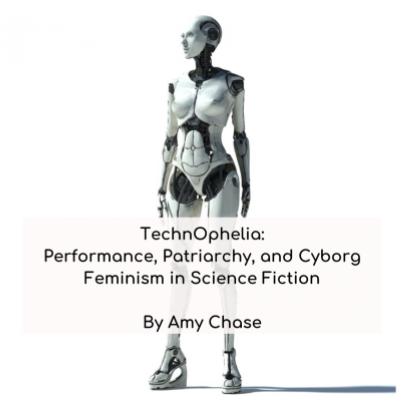
TechnOphelia: Performance, Patriarchy, and Cyborg Feminism in Science Fiction

By Amy Chase

If you are reading this thesis on a computer screen, you are already posthuman. The words you see here are ideas and representational patterns of intelligence separated from my body. For all you know, I could be a robot.

In her book How We Became Posthuman (1999), Katherine Hayles addresses the emerging distinction between corporeality and the more abstract reality of information in the age of technology. Society has already begun its transition to the age of the posthuman as culture, science, and even our understanding of self have moved beyond the state of human existence. According to Hayles, the posthuman view, “privileges informational pattern over material instantiation, so that embodiment…is seen as an accident of history rather than an inevitability of life” (Hayles 2). Posthumanism separates the mind and body and translates both into products of the informational age- body as the physical prosthesis that is manipulated by the mind, a mind which becomes a series of codes and informational patterns existing both with and without tangible form. In an age where technology is such an integral part of human life, there remains an inherent fear about losing oneself to the progressive creep of the digital, disembodied reality. If the patterns and codes of information and intelligence can exist without the body, then human form becomes less exceptional and more expendable.

In 1950, when computer technologies were just beginning to become more widely known to the public, computer scientist Alan Turing devised a test to see if machines could think and imitate human speech patterns through text in a way indistinguishable from a real person, all without the physical presence of another being. This “imitation game” became a paradigm for detecting whether the posthuman could flawlessly reproduce human intelligence through, “the formal generation and manipulation of informational patterns” (Hayles xi). In the Turing test, a human tester is situated apart from their subject, and must have a series of natural language conversations to determine if the subject is human or machine, and sometimes then if they are male or female. This test relies on the tester being unable to see the subjects, who may or may not exist on the other end of a computer terminal. An artificially intelligent entity should be able to replicate human vocal performance, even including facets of gender presentation, well enough to fool the tester, proving that machines can think. Internet users participate in their own form of Turing test via the CAPTCHA system on most websites, which ask users to prove their humanity by solving a letter puzzle or identify imagery that the typical bot program would fail to complete. CAPTCHA in this case stands for “Completely Automated Public Turing test to tell Computers and Humans Apart,” where the computer learns from the human answers, and adjusts its intelligence accordingly to appropriately act more human. For example, the program may ask users to identify a set of distorted words or correctly distinguish colors in a gridded photograph that the typical computer program cannot solve through an algorithm. Your answer teaches the computer how to respond, and its intelligence evolves. Eventually, even bots can fool bots by adapting their performance to the information garnered from human labor.

For science fiction literature, the figure of the robot, with its mechanical body and encoded consciousness, becomes the perfect metaphor for man seamlessly integrated with the machine. These androids are constructed in man’s own image, imbued with a replicated humanity in the form of codified patterns and programming that enables the appearance of consciousness. The term ‘robot’ first appeared in Czech writer Karel Čapek’s play Rossum’s Universal Robots (1920), which imagines the roboti as manufactured, artificial people made of synthetic organic matter. While they are not depicted as the same circuit-driven cyborgs often seen in modern science fiction, since their inception robots have been wrapped in identity politics. In Čapek’s writing, the robots are a servant class, but recognize humanity in themselves despite being mass-produced by artificial means. In fact, the word roboti in the original Czech language comes from robota, meaning slave labor. From inception, these creations have been viewed as subhuman, rather than posthuman, and performance and labor are encoded in robots from their origin. Their bodies are modeled on human figures, and much of the human notion of self is based on binary gender presentation- anything else is other and foreign. These cyborgs are then restricted by societal conventions, their interactions with the human dictated by hierarchical and patriarchal relationships between master and slave, tester and subject, and man and woman.  Science fiction literature imagines technology so advanced that these robots fulfill a variant of humanity and femininity that allows machines to replace marriages, cyborgs to satisfy sexual urges, and androids to perfectly reproduce art.

The following analyses examine the power of performative humanity as demonstrated by the artificial female figures of posthuman imagination in literature from 1938 through 2015, observing the traditions of gender roles juxtaposed with imagined visions of the future of technology. In a field so defined by Turing’s examination of gender performance, posthuman artificial intelligence reflects its human creators, revealing through discussions of sexuality, domesticity, and creativity exactly what it means to be a human in an increasingly technological era. Furthermore, by representing what it means to be human, cyborgs provide feminist scholars a lens through which to imagine the postgender future in which individuals can overcome the traditional binaries. Ultimately, by demonstrating human fetishization of embodiment and the prestige of disembodied intelligence, the female robots of science fiction reveal both the future potential and the present shortcomings of what it means to truly be a human in the posthuman world.


Deus Sex Machina- Humans and the Cyborgasmic

You must create a female for me, with whom I can live in the interchange of those sympathies necessary for my being.”

Frankenstein, Mary Shelley (1818)

The above quote from Frankenstein comes from the creature himself, who is a manufactured man committing himself to the pursuit of a very human desire for sexual companionship. The monster was made by Victor Frankenstein to be a human, and whether subconsciously or not, the being feels compelled here to make a request for his equal, a woman, in order to attain that humanity within him. This female creature is never fully realized, but in her partial construction begins to fulfill the human desires of her monstrous partner.  Reflecting on the state of technology’s purpose in Sex and the Posthuman Condition (2014), Michael Hauskeller notes that the machine “is always something that has been constructed to serve a certain purpose, which is not primarily [its] own purpose, but the constructor’s” (Hauskeller 16). Even the most highly advanced robot is an object with a programmed or otherwise intended directive, performing based on its internal code. Science fiction imagines the cyborg figure to be devoted to fulfilling their man-given purpose while also appearing as natural as possible, leading to a host of circumstances in which the robot technology replaces human ability in strength, precision, or durability. Robots are also increasingly being considered for their sexual purposes beyond those fantastical situations of space exploration and alien encounters in science fiction.

Hauskeller suggests that sexual cyborgs, or sexbots, ideally are, “always available to serve all our sexual needs…better and more reliably than any human lover could” (Hauskeller 18). Nonliving, they are touted as hygienic alternatives to innately human problems such as sexually transmitted infections, physical deficiencies, and even psychological responses regarding intimacy and issues of consent. In this way, the sexbot becomes a highly functioning object which consistently and tirelessly projects the “appearance of consciousness,” which is the closest that human inventors can achieve in replicating the artificial mind (Hauskeller 16). This reproduction of human interaction soothes our anxieties about interacting with the machine in such a manner that usually connotes expressions of love, partnership, or desire.

The carnal synthesis of man and the machine creates an experience that is both cybernetic and organic, but decidedly one-sided despite artificial insistence of arousal or interest in human pleasure. Sex fulfills no biological requirements for the cyborg, only mechanical obligations to satisfy the human partner and achieve their programmed ends. It is possible to consider the act of copulation with a robot to be a form of parasitism, where the human achieves sexual pleasure by feeding off of the mechanical agent. In contrast, feminist Jincey Lumpkin believes that humans should consider “that robots should have a choice too and not be treated as mere things… because constructing them without the choice to say no would cause duress,” suggesting that the artificial mind should have the same decision-making capacity as a human rather than simply responding to a constructed directive (Hauskeller 16). This element of human-cyborg relations prompts an interesting examination of human desire and the treatment of objects versus conscious beings, because if these robots are built to imitate humans, then moral reasoning processes, as well as the exercising of choice and preference, could be inbuilt in the artificially intelligent mind.

Considering this, science fiction literature opens the discussion into ideas of consensual sex with robots, treating them as if their humanity will become indistinguishable with our own. The robots will eventually deceive humans into believing in their own consciousness and life, but in creating these robotic partners, people relinquish their own understanding of the dichotomy between human consciousness and robotic simulation. When this becomes the case, the robots fall into the same constraints of gender performance and sexual roles as there are in current society. Sexual female robots, such as the following examples, represent the typically desired female body while projecting a woman’s consciousness, fulfilling male romantic desire in a heteronormative reconstruction of idealized human intimacy. It does not matter if the robot can or cannot feel, as at the core of these instances lies a test of the human capacity and even perhaps the human fear of coupling with the cyborg.

In Do Androids Dream of Electric Sheep? (1968), it takes a confrontation with a particularly amoral human male for Rick Deckard to qualify his romantic and sexual urges towards the Nexus-6 model Rachael Rosen: “Love toward a woman or an android imitation, it’s sex. Wake up and face yourself, Deckard. You wanted to go to bed with a female type of android- nothing more, nothing less” (Dick 143). To face himself, Deckard must confront his personal human wants versus those necessitated by his job as a bounty hunter. Throughout the novel, humans distinguish themselves from their android opponents through the innate emotional concept of empathy, which the robots supposedly lack. Phil Resch, a ruthless bounty hunter, even warns Deckard, “Don’t kill her- or be present when she’s killed- and then feel physically attracted. Do it the other way” (Dick 143). Deckard must act on his urge before the robot is retired, or else risk failing to fulfill both his hunting assignment and his human desire for sex. Falling in love with robots, Hauskeller claims, “proves we are easily duped,” and, “we will find it very difficult not to attribute consciousness,” to an advanced enough robot based on its design and presentation of human behaviors (Hauskeller 20). Deckard finds himself in the position of attributing consciousness to Rachael Rosen, “because she- it- was physically attractive,” and with that he projects his own sexual desires onto her, his judgment sufficiently clouded by the advanced design of the Rosen Corporation’s artificial humans (Dick 143).

When he and Rachael have an intimate encounter in a hotel, Rick Deckard continues to, “wonder what it’s like to kiss an android,” and then acts on his curiosity: “Leaning forward an inch, he kissed her dry lips. No reaction followed; Rachael remained impassive. As if unaffected. And yet he sensed otherwise. Or perhaps it was wishful thinking” (Dick 189). Rachael Rosen does not project the behavioral output of arousal or stimulation, and yet Deckard still considers her sexually appealing, though he comments on her figure as being “neutral, nonsexual” (Dick 187). Her unaffected nature almost mirrors that of a disinterested woman playing hard to get, which some men consider more attractive and desirous than a woman who is too wholly interested. Mechanical indifference translates to human curiosity, and Deckard’s wishful thinking of Rachael’s reaction contributes to his sexual satisfaction. Hauskeller suggests that in the future, “the pleasures of the body may eventually be completely disconnected from the actual body as its (necessary) source” as anatomical robots who can recreate those sexual experiences become increasingly virtual (6). Rachael’s lack of physical output incites Deckard’s arousal even without the integration of her body into a sexual encounter with the bounty hunter.

Hauskeller cites a historical precedent for male erotic desire towards nonliving female bodies when Ovid’s Pygmalion character finds himself attracted to his own statue because, “she is supposedly a living woman, but without the flaws… she is perfect and pure, and perfectly usable” (28). The word “usable” suggests the servitude of the robot body, relegating the artificial woman to the status of an object meant for consumption by the male owner. This relates to the robot’s origins as a slave figure, and in the context of Dick’s novel, recalls the status of the escaped Nexus-6 androids as servants for the emigrants of Mars. Rachael suggests “it’s an illusion that I- I personally- really exist; I’m just a representative of a type” and uses diction of purity to describe the “clean, noble, virgin” bed she plans to seduce Deckard on (Dick 193). Because she is synthetic, Rachael does not adhere to the socially-constructed idea of a biological virginity but rather a purity of herself because flesh and its pleasures represent inherent flaws of humanity. Interestingly, she has seduced other bounty hunters before Deckard and so does not represent a sexual naivety typically associated with a virginal state. Rachael assures Deckard he is “not going to bed with a woman,” which is, “convincing if you don’t think too much about it. But if you think too much, if you reflect on what you’re doing- you can’t go on,” in a similar manner to how Hauskeller suggests humans can allow ourselves to be fooled by the robots’ programming into believing their consciousness and consent (Dick 194). Contrary to the ideal imagination of the sexbot figure, Rachael behaves in a sexual manner mostly to her benefit, although the experience also simultaneously satisfies Deckard’s innate desires.

When deeply confused by his own sexual urges towards Ava in Alex Garland’s Ex Machina (2015), Caleb confronts the man who programmed the cyborg and enquires about her capacity to act autonomously on her desires. Nathan insists that Ava behaves freely due to the advanced coding in her mind. He suggests he “programmed her to be heterosexual just like,” anyone else, putting the exact nature of robot’s sexuality in line with the young man’s own innate desires (Garland). Caleb rejects the idea that he has been programmed to be heterosexual by any external factors, believing his sexuality to be an innate part of his humanity. The film plays with the debate of nature versus nurture, suggesting that humans are programmed by their experience with information coded by some outside source to call into question the ultimate end of our sexual desires. Either sex is something a human is designed to do, like an android has a purpose, or it naturally occurs as an instinctive human behavior. “Consciousness is not something inferred from behavior; it is behavior,” according to Hauskeller, and Caleb’s anxiety over Ava’s programming calls his own human exceptionalism into question (23). If humans, and more specifically human sexuality can be programmed, then Caleb has the potential to be manipulated based on his own purpose given by the force behind his desires. This raises the anxiety surrounding Caleb’s perception of himself and his own autonomy.

Visually, Ava has been designed to appear like an attractive human woman, although some of her circuitry is exposed in order to reinforce that she is, indeed, a robot. Nathan even confirms that he programmed her to receive sensory feedback, “so if you want to screw her, mechanically speaking, you can” (Garland). He uses the word “mechanically,” which here has double meaning relating to the mechanics of sexual intercourse and also the act of copulating with an inorganic, mechanical being. Ava’s hands and face resemble human flesh, while the rest of her is more explicitly transparent mesh and wires. Existing between the mechanical and the organic, however, are her breasts and hips, which are constructed of grey material that does not allow the viewer to see through her structure. Rather, these areas function like a bra and underwear, suggesting that perhaps there is some bit of womanhood behind her exterior shell, including the, “cavity between her legs with a concentration of sensors,” Nathan has included in her design (Garland). Ava’s sexual potential becomes a key part of the Turing test exercise because of this emphasis, as Caleb fears her flirting will cloud his judgment because again, “we will find it very difficult not to attribute consciousness,” to intelligent, sexual robots with whom humans may eventually engage (Hauskeller 20). In the case of Ava, Nathan has devised sensors that will effectively provide positive feedback to her programmed mind, allowing her to react to a phallic stimulus with pleasure to encourage her proper participation in transhuman intercourse. While she and Caleb never reach this point in the film, this suggests that her creator, Nathan, has tested this programmed feature to ensure her appropriate execution of her sexual simulations.

Caleb eventually realizes that the inventor has designed, “her face based on my pornography profile,” with data scraped from his search engine inputs (Garland). The young man’s digital footprint has provided all the code that Nathan needed to construct Ava on the theory that, “a real human lover can be replaced by a robot without loss if and only if other people can already never be more than a means for us,” (Hauskeller 14). By “a means,” Hauskeller refers to a means to sexual arousal- while Ava is not explicitly presented as a sexual partner for Caleb, he inevitably finds himself attracted to her because she occupies the same space as a pornographic performer who he observes as a means to pleasure himself. In the film, Ava and Caleb most often interact from opposite sides of a glass enclosure, adding an element of removal to Caleb’s viewing of the Turing test subject. While in a true Turing test the examiner would be unable to see the test subject, the added visual dimension allows Nathan’s design to play on the man’s personal tastes in women, which the inventor describes as, “a consequence of accumulated external stimulus, that you probably didn’t even register as they registered with you” (Garland). These stimuli provide the “programming” of Caleb’s heterosexuality that the inventor alludes to, and result in his potential to be manipulated by these desires. The glass walls of the enclosure are arranged to recreate the experience of viewing pornography, where Caleb looks into an enclosed “screen” that displays the object of his desire. The layers of separation in the Turing test environment further the distance of the isolated tester gazing in on his fetishized subject. Ava’s features optimize those stimuli which have, whether unconsciously or not, contributed to Caleb’s self-pleasuring interactions within the digital sphere. As he views Ava from a removed position, she subtly fulfills those innate voyeuristic urges that led the man to watch porn in the first place. While he may not believe that his sexuality has been programmed into him, Ex Machina suggests that his data may then be used in turn to program the exact object of his desire, allowing sexuality to be exploited by the resultant robot.

In the humorous and frightening case of Ira Levin’s satire The Stepford Wives (1972), the robotic replicas that replace the working women of the sleepy Connecticut suburb are augmented physically to fulfill the needs of their previously unsatisfied husbands, in accordance with Hauskeller’s definition of the ideal sexbot. Joanna Eberhart takes constant notice of the buxom figures of her neighbors, like Carol with her, “profile of too-big bosom…her big purpled breasts,” which, “bobbed with her scrubbing” (Levin 9). After her closest ally Bobbie Markowe has been replaced with a lobotomized, robotic double, Joanna finds her, “wearing some kind of padded high-uplift bra under her green sweater, and a hip-whittling girdle under the brown pleated skirt,” as if being a proper Stepford wife necessitates having enhanced breasts (Levin 81-2). Built as a reflection of their husbands’ desires, these wives have their intellectual substance reduced, replaced with artificial augmentation of phenotypic features that make women alluring to men. While Hauskeller states that the perfect sexbots will, “make it far easier to forget that they are just machines who do not really think or feel anything,” the men of Stepford find their wives’ lack of thought even more attractive, as it makes them less likely to disagree with their chores and sexual responsibilities in the marriage (Hauskeller 13).

Joanna asks “the going price for a stay-in-the-kitchen wife with big boobs and no demands,” curious to know the true cost of turning the women into domestic slaves (Levin 105). With another reference to the women’s breasts, the sexual allure of the robot women is highlighted again as one of the few defining features of these automatons. Along with the physically attractive figure, the Stepford sexbots have “no demands,” as mindless, happy slaves to their husbands’ whims. Hauskeller suggests that one psychological reason that sexual robots appeal to human sensibilities is that they allow “us to only ever confront ourselves without ever having to confront ourselves,” due to the nature of displacing our own identity into the robotic other (Hauskeller 77). Cyborg sex partners allow us to avoid rejection by taking out the conscious person on the other side of the act; the person who has “demands” and has the ability to refuse the sexual encounter. One evening, Walter Eberhart returns home late following a meeting at the Men’s Association and wakes Joanna by pleasuring himself in bed:

“The bed was shaking…each shake was accompanied by a faint spring-squeak, again and again and again. It was Walter who was shaking… Had he been- masturbating?

He lay still. ‘I didn’t want to wake you,’ he said. ‘It’s after two.’

‘You could have,’ she said. ‘Woke me. I wouldn’t have minded.’

He didn’t say anything” (Levin 15).

By now, Joanna’s husband Walter has been exposed to the Men’s Association and its operation of replacing the wives of Stepford with docile robot doubles. This initially one-sided sexual encounter illustrates an instance of that fear of sexual rejection Hauskeller believes that robots allow us to avoid. Walter must take to stimulating himself while his wife is asleep, believing that she will not consent to joining him in intercourse if he interrupts her rest. Joanna, once woken, eventually decides to have sex with him in what, “turned out to be one of their best times ever- for her, at least” (Levin 17). However, while she was asleep and therefore unable to consent, Walter resorted to instead taking care of his own urges through masturbation, the ultimate sexual self-encounter. The Stepford wives manufactured by the Men’s Association overcome this problem as they are perpetually preoccupied with pleasing their husbands in both the domestic and sexual realms.

In the Marvel Comics serial The Vision (2015), the synthetic android Vision constructs a wife for himself when he can no longer associate with the human woman he loves, a hero named Wanda. From his wife Virginia’s mental structure combined with his, he generates two children with whom they form a nuclear family unit and attempt to pass as normal in their suburban neighborhood. This series presents the idea of a robot creating his own robotic partner, done with a “certain purpose, which is…the constructor’s” intent to have an artificial but equal sexual companion to replace what he lost with Wanda, a human woman (Hauskeller 16). In a full page flashback sequence depicting Wanda and Vision in bed together, visual signs of passion surround the couple. With Bellaire’s coloring tinting the page with red and pinks, the sense of organic heat and sexual arousal saturate the page. Behind them is the caption “I Too Shall Be Saved By Love”, which is the title of the single issue as well as a reference to a quote spoken by the android in a 1963 issue of the Avengers series. The syntax reflects Vision’s own complex speech mannerisms, and suggests that love in whatever form he achieves it will make him redeemable, in this case more organic than synthetic. Artist Michael Walsh includes the sight of tousled garments to demonstrate the haste and visceral nature of Vision and Wanda’s sexual encounter. The curvature of the headboard and the pillows behind the resting couple further attest to a certain natural softness involved in tender intimacy (King 3).  

The issue’s conclusion loops back to the opening scene recast on the last page with the two synthetic androids, Vision and his wife Virginia, sitting upright in a shared bed, cold and aloof. Here, Virginia represents “a ‘soulless’ lover” which is one type of what Hauskeller identifies as “unsatisfying women,” and Walsh’s distinct alterations to the environment of the opening scene as well as Bellaire’s appropriate coloration of the page reveal the loss of life and soul in Vision’s romantic relations following Wanda’s departure (Hauskeller 23). The couple’s headboard is now square and the bed lacks any pillows, revealing that the eroticism and intimacy have been removed and replaced with distance and mechanism. Bellaire’s color palette switches here to blues and greys, recreating the sense of the mechanical bodies not producing any heat. This physical coldness can also indicate an emotional coldness, and again there can be sexual desire found in being somewhat disinterested. Here, though, the coldness is mutual, with the androids’ red tones dimmed by the darkness of the bedroom. Folded clothes and shadows cast over their faces complete this uncomfortable scene of mechanical marital disconnect, which emphasizes the loss of soul in this relationship (King 22).  

While her name is meant to be alliterative, as all of Vision’s family have names beginning with ‘V’, his wife’s name Virginia suggests a virginal quality and the removal of the messy human intimacy he once experienced with Wanda in exchange for a new, pure form. In this way, she does not exactly function like a sex robot, but is still constructed to replace a lack of human intimacy in a sterile manner. Hauskeller suggests that sexbots, “behave in all respects exactly like we would expect someone to behave who really loved us…they have been designed that way” (21). If these sexbots behave exactly as humans expect, then perhaps human reactions to these robots are also predictable behavior, acting to elicit a certain response from the machine. While Vision is not human, he represents the more autonomous side of their mechanical marriage. Virginia exhibits the appearance of consciousness and romantic partnership through her programming designed to imitate Wanda, and Vision behaves formulaically, hoping to revive that lost experience through vocal performative testing. As Vision trots out the same “talking toaster” joke to his wife as he had Wanda at the start of the issue, it becomes clear that he created his wife Virginia to exactly replace what he lost as he tries to reconstruct everything from memories. Her “certain purpose” in life should position her as an equal to her husband because they are both androids, but her artificiality and programmed directive fill a void in Vision’s life and service his egoism and desire for “normalcy” (Hauskeller 16).  

Vision represents the human and creator in the relationship, perhaps due to the fact that although he is an android, he has had more life experience than any of his artificial family. By retelling the joke, he is testing his wife, hoping she will react with the same humor as his human lover had once done. While it remains unseen exactly how Virginia reacts to the punchline, there is a sense of unease as the joke implies an examination of the android couple’s own sentience and capacity to express emotion. Vision has not been “saved by love” as he had hoped initially, but rather becomes trapped by it, deluding himself with a wife “designed to behave as if” she loves him while he is simultaneously obligated to behave as if he loves her in the same way (Hauskeller 21). Pairing oneself with a robot in each of these cases serves to replace a lost intimacy and eliminate the element of consent from the coupling of a human male and a robotic female. This occurs at the expense of humanity, effectively sterilizing the relationship and isolating it, trading longevity for constant instant gratification from the idealized sexbot figure, suggesting that humans too may be concerned with satisfying their internal, preprogrammed compulsions.


Majordomo Arigato, Mrs. Roboto- Programming the Domestic

I saw it all now. That beautiful, lady-like girl that had ushered me into the room, whom I had taken for his wife, was an automaton! That doll-like expression was due to the fact that she was a doll.”

The Lady Automaton, E. E. Kellett (1901)


Even before 1901 when Kellett wrote the short story The Lady Automaton, popular imagination has been fascinated with the idea of having a doll, statue, or other artificial being for a companion, slave, or even a spouse.  These beings appear human, but lack fundamental aspects of being biologically alive, which is a state of conflict that can be unsettling. In Freud’s theory of The Uncanny (1919), he cites the German word unheimlich, which is the opposite of heimlich meaning “familiar, belonging to the home” as the origin for his explanation of this upsetting psychological sensation (Freud 2). Unheimlich, and from that the uncanny, represents “that class of the terrifying which leads back to something long known to us”, a frightening liminal experience that simultaneously appears to be familiar but lacks the elements of truth that humans can understand (Freud 1). The concept of uncanniness describes alter-humans and states of existence, such as a dead corpse that once lived or a humanoid robot exposing circuits where flesh and blood should be. Masahiro Mori described “this type of unsettling experience as ‘the uncanny valley’- that psychic place when someone discovers that what looks animate is not really alive” (Wosk 7). For example, Mori details the experience of touching “a realistic-looking prosthetic hand” that “when touched, lacks the temperature of the human body and creates a sense of strangeness, unfamiliarity, or alienation, as though touching the hand of a corpse” (Wosk 155). When asked if she could experience empathy for other robots, Rachael Rosen feels “something like that. Identification; there goes I… If I die…maybe I’ll be born again when the Rosen Association stamps out its next unit of my subtype” (Dick 189). She recognizes other versions of her own robotic model type to be familiar, but frightening in their difference from her: she observes a self that is not herself.  Based on appearances, humans have an expectation of how interaction with these uncanny bodies should occur, but confrontation with a discordant or unusual sensation or experience causes terror of the irregular but somehow familiar.

For as ‘un-homelike’ as the female robot is, science fiction literature and media posits her as the perfect domestic caretaker and homemaker. To reduce the fear of the uncanny robot woman, she must be made completely known and familiar. In My Fair Ladies, Julie Wosk catalogues varieties of simulated women and notes that “robots…will have future caretaking roles, but it is largely men who have created ultrarealistic female interactive robots”.  These cyborgs embody “the perfect woman: a fusion of happy domesticity and sexy playmate,” and the idea of programming prescribed gender performance somehow eases the terror of the alter-human in the home (Wosk 3). Her appearance is familiar, and her requisite motherly warmth and spousal affection is expected. However, the robot lacks temperature, consciousness, and life, becoming a cold specter of perceptions of the feminine and domestic within the home. This lack of warmth both emotionally and physically betrays the expected comfort of a mother’s love, or a lover’s touch. Machine metals are cold to the touch, but artificial kindness is cold to the soul, playing into the uncanny home life of these robots. These automata reinforce a traditional nuclear family structure, replacing wives and mothers with a doting droid figure with a preprogrammed willingness to keep house, effectively preventing the figure from moving into the outside world.

Betty Friedan’s The Feminine Mystique (1963) plays a key role in the insidiousness of the cyborg conspiracy plaguing The Stepford Wives. Often credited with sparking the movement of second-wave feminism, Friedan’s work highlights what she called the “problem that has no name,” a general sense of unhappiness and lack of fulfillment in American housewives (Friedan 15). Where first-wave feminism worked towards advances in women’s suffrage, second-wave feminism as a movement focused on women’s reproductive rights as well as sexuality, domestic abuse, and women in the workplace. The Stepford Wives reacts to this shift in attention, using The Feminine Mystique not as a catalyst for positive change within the novel, but as the beginning of the husbands’ reactionary scrambling to control their free-thinking wives and rejecting the idea of unhappy housewives. Joanna Eberhart discovers that a Stepford Women’s Association used to exist before the women supposedly lost interest. In this organization, the women discussed Friedan’s text and engaged with civic issues before, “some of the women moved away… and the rest of us just lost interest in it,” according to former president Kit Sundersen (Levin 42). The organization was over fifty members strong, but their gatherings led to fear on the part of their husbands, who worried that this intellectual discussion would move the women away from their roles as housewives and caretakers, rather making them what Friedan describes as, “high-dominance women… free to choose rather than be bound by convention” (Friedan 320). The disbanding of the Women’s Association coincides with the introduction of Stepford’s own animatronic replacements for these women, which also led to the decline of the Stepford League of Women Voters. While the housewives are revealed to be automata at the conclusion of the novel, the Stepford wives stand for women brainwashed by the pressures of maintaining appearances and conforming in 70’s suburbia. These robots represent politically-minded women removed from the public sphere and replaced with artificially cheerful housewives who perform slavish work for the men of Stepford, becoming bound by the same convention that Friedan encourages women to overcome.

Having “never found a woman who fitted that ‘happy housewife’ image”, Friedan explains that business and the sheer amount of time that domestic housework takes upholds the damaging image that the housewives feel a great sense of purpose in their roles (Friedan 237). Maintaining the illusion of dedication stems from a sense of insecurity that should they stop cleaning, these housewives will have no other power in the home. Throughout her brief time in Stepford, Joanna Eberhart notices the “steady mechanical movements” of the other women who polish trophies and wax the floors of their homes tirelessly (Levin 64). Before suspecting them of being robots, she considers her neighbors to be “compulsive [hausfraus]” and “asking-to-be-exploited” patsies, lacking any ability to stand up against their husbands (Levin 9). “The old mystique of feminine inferiority” gave way to making women’s roles “in the home equal to man’s role in society” in order to keep women complacent in cooking and cleaning for the household (Friedan 239). Joanna fears that by becoming too engaged in household maintenance over her photography profession, she will relinquish her autonomy to a husband who will expect her to perform all of the domestic chores as the other wives in town do.

In order to ensure the women of Stepford adhere to their responsibilities, the Men’s Association of Stepford takes the concept of this mystique one step further in actually manufacturing robot spouses who uphold the virtues of housewifery in the very same way that Friedan asserts that women are oppressed. After “the author of The Feminine Mystique addressed members of the Stepford Women’s Club,” Stepford Library records indicate the quick decline of the association that encouraged the women to seek fulfillment and community beyond the home (Levin 37). Joanna tries to speak with the former club president about the experience, but finds the other woman to be “like an actress in a commercial…pleased with detergents and floor wax, with cleansers and shampoos, and deodorants…playing suburban housewives unconvincingly, too nicey-nice to be real” (Levin 42-3). Joanna’s assessment of the woman’s artifice recalls Friedan’s notion of the “sexual sell” in which “the manufacturer of a certain cleaning device…let the housewife have the illusion that she has become a professional, an expert in determining which cleaning tools to use for specific jobs,” reinforcing the subjugation of women within the domestic sphere (Friedan 215). The Stepford wives make banal choices of which detergent to wash clothes with, or which wax to clean the floor with, and while it gives a semblance of control to the woman, her control in the domestic sphere keeps her subservient to the others in the household.

This illusion of choosing power upholds the mystique that keeps women unhappy in their homes as the role of housewife becomes an all-encompassing “career” that absorbs time and energy. Joanna suggests the buxom, cheerful women are “playing…unconvincingly” and too “nicey-nice to be real,” because the happiness exerted by the Stepford housewives conflicts with her notions of femininity and independence. It also challenges Friedan’s theories which inspired second-wave feminists to seek new opportunities for women beyond the cloyingly domestic.  This cognitive dissonance, as well as Wosk’s assertion that man’s perfect robot fuses “happy domesticity” with a “sexy playmate,” creates the sense of uncanniness that leads Joanna to further investigate the truth behind the relentlessly robotic housewives. The Stepford simulations silence opposition to the Men’s Association by removing woman’s consciousness from the equation entirely, relying on the gender performance of machines and antiquated ideals of the woman’s role in the home to keep the illusion alive.

The eponymous Helen in Lester Del Rey’s short story Helen O’Loy (1938) functions so well as a constructed woman that she even fools her husband into forgetting that he built her out of metal as an experiment with a friend (Foley 371). Fresh from her packaging, Helen “was designed to express emotions…ready to simulate every human action” with more advanced technology than the previous robot built by Dave and Phil (Del Rey 52). Her name is an allusion to the famed Helen of Troy, whose beauty started a war, although the men call their own creation O’Loy as a shortened form of “alloy”, to reinforce that she “was… a dream in spun plastics and metals” (Del Rey 49). While Helen embodies a new technology as a robot, she also represents classical beauty, femininity, and sensitivity in accordance with conventions of the perfect housewife. The men consider her the ideal female form, not unlike the idea of the girl-next-door type in this era, and this success thrives on gender performance as well as her physical allure and comparison to classic beauty in name and structure.

As a robot, Helen can only simulate human action and not truly live it, unlike Phil, the endocrinologist, who has “performed plenty of delicate operations on living tissues,” before working with Dave to construct Helen (Del Rey 52). In Anatomy of a Robot (2014), Despina Kakoudaki notes:

“Because of the unusual romantic tone of the story, ‘Helen O’Loy’ also presents an early version of a performative approach to humanity, in Helen’s actions, her recognition of the encoded nature of femininity, and her adherence to normative gender roles ensure her ability to pass as a woman” (Kakoudaki 187).

Helen’s performance as a human successfully allows her husband to forget that he built her from disparate robotic parts. At first, Dave grows increasingly upset with Helen’s infatuation with him, and Phil even informs her that “a man wants flesh and blood, not rubber and metal,” but Helen insists that in her mind, “I am a woman. And you know how perfectly I’m made to imitate a real woman…in all ways” (Del Rey 61). She primarily concerns herself with notions of romantic love, accommodating Dave in all the ways that she knows a woman should behave towards a man. While Phil insists that a real man does not want, “rubber and metal,” they call her a “dream in… metals,” which conflicts with their desire of her perfect femininity. Helen finds herself imitating living behaviors, although her sense of identity is one of being a woman, causing brief cognitive dissonance between her understanding of self and of her motivations. In accordance with Betty Friedan’s assessments of women’s psychological states where the high-dominance woman breaks free of gender conventions, “the low-dominance woman was not free to be herself, she was other-directed. The more her self-depreciation, self-distrust, the more likely she was to…wish she were more like someone else” (Friedan 320). Helen O’Loy yearns to be a woman that can please Dave’s sensibilities, and so reads a series of romantic books to help her better understand how to imitate that person. Friedan’s language of “other-directed” recalls the robotic, programmed nature of Helen, as well as the other domestic housewife robots, whose directive comes from the creator or husband figure.

Eventually, Dave’s resistance to Helen’s advances wears down and the two become happily married after realizing that, “no man acts the way Dave had been acting because he hates a girl; only because he thinks he does- and thinks wrong” (Del Rey 64). She makes a perfect bride and homemaker, and the couple grow up happy, even without having children. In his age, Dave begins to forget that he built his wife many years prior. Eventually, Helen enlists the help of Phil to physically alter her face as Dave grows older so that she may properly maintain the illusion of her womanhood for her husband, as she is unable to age due to her synthetic nature. Like a woman with her makeup Helen, “put lines in her face and grayed her hair without letting Dave know she wasn’t growing old with him” (Del Rey 64). In this sense, her uncanny nature lends itself to a sense of timelessness, not unlike her classical beauty for which she was named. Helen exists outside of human aging, being a machine, and must therefore manually alter herself to appear as something she is not, eventually fooling even the men who created her from repurposed parts.

In The Vision, Vision and Virginia execute functions of normal marital love, but recognizing her artifice leads Vision to have anxieties over his wife’s uncanny nature and the deceptive appearances of his own family life. Waking in the middle of the night, Vision finds “himself in a state of dread, his thoughts caught on a repeating image of the day he first saw his wife open her eyes” (King 1.17). Her eyes seem “like a camera lens adjusting to the light” as her “pupils grow and recede” in this memory, and the mechanism of her awakening frightens Vision (King 1.17). Onto her he places anxieties and hopes for a normal family life, but among their human neighbors in the suburb, the illusion of a happy household begins to fade. She is the uncanny body, corpse-like although she functions as if she is alive. Virginia provides Vision with a perfect partner, but in doing so simultaneously removes his hope to regain the love he lost. Interestingly enough, Vision himself is an android built of the same materials as his wife, yet she inspires feelings of uncanny dread in him. In his theory of the uncanny, Freud asserts that “a morbid anxiety connected with the eyes” sometimes represents “a substitute for the dread of castration” (Freud 7). While Vision’s fright comes from the memory of his wife’s eyes, the day she awoke from slumber to mechanical life represents a loss of Vision’s human love. He programs Virginia’s mind to imitate the thought patterns of Wanda, the human woman who used to be romantically engaged with the android man. Virginia’s body, however, reminds her husband that she is artifice. Still, Vision repeats to himself the demand that “I must love her…this is my wife. I must love her,” in order to maintain the image of mechanical marital bliss (King 1.17). He “must” love her because he lacks a reasonable alternative- he is her creator and her husband, the reason for her life. She sustains that notion of “happy domesticity” that men seek when they create cyborg counterparts, where Vision increasingly fails to perpetuate the idea of normalcy he hoped the family would bring to him.

In contrast to the feminine mystique of upholding the sanitation and tidiness of the home, Virginia suggests to a neighbor that “to get to clean you are required to introduce substantive turmoil” to the order of the house (King 6.10). In her case, the substantive turmoil occurs when she destroys the furniture while malfunctioning, asserting that “everything is normal” after the family has come under great scrutiny by their neighbors (King 5.12). Friedan assesses that the only way “the young housewife was supposed to express herself, and not feel guilty about it, was in buying products for the home-and-family” (Friedan 222). As the series progresses, Virginia becomes increasingly volatile while the family comes under scrutiny for the strange events that transpire after they join the suburban neighborhood, expressing herself not through purchases but through rage directed at her own residence. This results in her breaking furniture and destroying the walls such that the home nearly becomes uninhabitable. She struggles to maintain appearances based on human standards of normalcy, and the more the family tries, “to get to clean,” the further they cause discomfort not only in their own residence but also in their neighborhood.  

Her domesticity is not happy, nor is it built on choosing the best products with which to maintain her home. Rather, Virginia’s household disarray reflects the biblical fear that, “women would destroy the home and make slaves of men,” which was used as a justification for making women subservient in the family (Friedan 87). Virginia’s rage does destroy the home not due to the fact that she is a woman, but due to her uncanny nature in an unnatural, domestic setting. Her uncanniness is what keeps her husband enslaved to thinking that he “must love her,” because of the purpose that he built her for, or else lose the illusion of peaceful and happy domesticity. In their struggle to uphold the standards of a conventional, suburban existence, their physical home transforms into unhospitable space that becomes as unhomelike as they themselves, an android and his constructed facsimile of a family performing humanity. While these robots are asked to keep house, slowly they unmake the traditional structure of patriarchy and domesticity within the home.


Art-Official Intelligence- Testing Creative Capacity

She’s a triumph of your art and of her dressmaker’s; but if you suppose for a moment that she doesn’t give herself away in every sentence she utters, you must be perfectly cracked about her.”

Pygmalion, George Bernard Shaw (1913)


The importance of vocal performance in Shaw’s Pygmalion, so named after Ovid’s fictional sculptor, reveals an important aspect of science fiction’s obsession with humanoid robots. There is a distinction between the outward, beautiful embodiment of a woman and the thoughts she voices, which expose her intelligence and true nature. As Megan Foley assesses in “Prove You’re Human” (2014), her article about interactions and fetishization of material embodiment, “the voice, and the fantasy of bodily presence it sustains, have become a function of informational patterns themselves” (Foley 369). The Turing test serves as a real-world paradigm for much of the imagination of science fiction, whose robots are advanced beyond the capabilities of the technology Turing worked with. In the age of the posthuman, intelligence “becomes a property of the formal manipulation of symbols,” leading to new fictional representations of how humans will test a robot’s humanity (Foley 369). When the machine mind can outsmart a human in code manipulation, humanity must turn to other sorts of performative examinations that are supposedly more difficult to replicate.

In the case of science fiction narratives that move beyond the parameters established by Turing, it is the creative capacity of the android figure which becomes the new determining factor when assessing that being’s humanity. This act demonstrates “a pervasive desire to recover the lost guarantee of a corporeally present human subject on the other side of the computer screen” and in the case of science fiction, uncover the humanity inside the mind of the present android figure (Foley 372). Art and empathy, as is the case with Dick’s Voigt-Kampff test or the visually-oriented Turing variant in Ex Machina, present opportunities for the disembodied creativity to become corporeal in order to prove whether the robot has a soul, a concept elusive even to many humans. This results in the idolization of embodiment and performative labor as humans simultaneously hope to interact with something indelibly alive and embodied, and fear the robot’s ability to fully recreate something thought to be intrinsically human. Speech patterns and other human thought processes can be replicated by algorithms written into computer programs but ideas of talent and creative impulse are thought to be unique to civilization. When a CAPTCHA program asks a user to indicate which segments of an image contain flowers or street signs, the formulaic robot mind appropriates the labor of the human by incorporating the visual information into its database and ascribing the appropriate meaning to the image. Robots can be instructed to reproduce works of music and art already in circulation, but whether they can produce original artistic content seems to be the standard by which human testers measure true consciousness- this is to say nothing of whether humans can truly create new original content. Creativity serves as an indicator for humanity in science fiction, whose androids are advanced enough already to evade detection of more basic Turing tests, and reinforces valuation of those robots whose qualitative labor can remind us of what it means to be innately human.

While undergoing Turing test applications to assess whether she has true consciousness, Ava from Ex Machina produces several pieces of artwork, the first of which is a series of geometric lines in black ink that she claims mean nothing to her. Ava’s first drawing bears resemblance to the surrealist practice of automatism, her paper covered in abstract markings. This practice arose when 20th century artists let their unconscious minds come forth onto the canvas in drawings composed of patterns and unspecific figures. Automatic art hoped to make sense of a war-torn world and allow artists to cope with confusion and trauma. Ava’s art signifies her attempt to access her unconscious mind and produce work representing her cognitive abilities, whether or not the artwork has a defined subject. Ava makes, “drawings every day. But I never know what they’re of,” which does not deter her from creation, although she seeks answers and hopes that Caleb will tell her what the art represents (Garland). Caleb, the human, asks her, “to sketch something specific…like an object or a person,” rather than the formless shapes that neither can ascribe direct meaning to (Garland).

Although Caleb believes that Ava’s artwork would be more beautiful depicting a particular subject, Nathan’s décor brings him to the realization that constant cognizance would never result in artwork being created. Standing in front of a Jackson Pollock painting, Nathan explains that the artist, “let his mind go blank, and his hand go where it wanted. Not deliberate, not random. Someplace in between. They called it automatic art” (Garland). While there is no doubt that Pollock stands among the more famous American artists, his process of drip painting mirrors that of Ava’s ink drawings, wherein she produces work without a specific intent, instead letting her artificial mind access its more unconscious functions. By employing this process in her artwork, Ava does not merely recreate a specific work, as most robots are prone to simply imitate behaviors that have been programmed into them. Here, the “challenge is not to act automatically. It’s to find an action that is not automatic,” and access that unconscious self which allows the artist to produce new work free from constraints of guided intention (Garland).

When Caleb challenges her to draw something more recognizable, he changes her automatic artwork into something purposeful, at which point she can use that intent of meaning to manipulate her observer. Foley suggests that, “cybernetic circuits expand their capacities by appropriating the labor of human bodies,” as Ava appropriates Caleb’s suggestions for art and presents them to him in order to win his sympathies; first, with a drawing of her own enclosure and then with a portrait of him, after which he finds himself devoted to helping Ava escape (Garland). After being shown the portrait Ava has drawn of him, which was torn to pieces by Nathan just prior to this meeting, Caleb becomes resolute in his attempt to outwit their observer and liberate the robot from her confines. In this way, while it seems that Ava produces labor for her tester by creating drawings with his specific subjects in mind, she as the robot actually benefits from his human labor, incorporating his requests into a drawing that wins his allegiance and causes him to work to her benefit, similar to the aforementioned CAPTCHA program. Rather than recognizing the implications of an artificial intelligence creating automatic artwork, Caleb focuses on the embodiment of her drawings and what they represent about her clear and present thoughts, and seeing himself as the subject of her guided drawing proves the final distraction in understanding the processes of her consciousness.

When considering his assignment to eliminate her in Do Androids Dream of Electric Sheep?, Rick Deckard judges android opera singer Luba Luft mainly by the cultural value of her creative output. Upon discovering the renegade android performing Mozart’s The Magic Flute opera, “he found himself surprised at the quality of her voice; it rated with that of the best, even that of notables in collection of historic tapes” (Dick 99). Deckard’s context for the beauty of her voice consists of these historic tapes which are auditory reproductions such as cassettes or records which invoke Foley’s idea of the vocal performative act. As far as he knows, the recordings capture the voices of singers from humanity’s past before World War Terminus, but without absolute certainty, they represent “the erasure of embodiment” by reproducing only the vocal performance of whoever composed the musical tracks (Foley 369). By holding the “historic tapes” in esteem while simultaneously attributing Luba’s talent to her programmed functions, Deckard devalues the opera singer because he can observe her visual presence and knows that she is a product constructed by the Rosen Association, whereas he seems to be certain that his musical recordings comprise human voices of the past.  

Considering that his mission involves retiring, or killing, Luba, Rick Deckard wonders what loss of cultural value will occur upon her death because, “she was really a superb singer… how can a talent like that be a liability to our society? But it wasn’t the talent, he told himself; it was she herself” (Dick 137). As a bounty hunter, “he realized, I’m part of the form-destroying process of entropy. The Rosen Association creates and I unmake,” positing Luba Luft as a created entity which Deckard must destroy because her very embodiment represents the danger of android bodies integrating indistinguishably with humans (Dick 98). Her talent, which is in this case her voice, is more valuable to the world than her body which, being a Nexus-6 type, poses a danger to human society. The escaped Nexus-6 models were a former source of labor for the emigrants of Mars, having killed several humans to escape their slavery and hide on Earth. Deckard’s specific purpose in killing these robots unmakes those embodied androids that the Rosen Association produces, and while he may succeed in destroying the form, the corporation retains the intangible code and information with which the robots are constructed.  

After being tracked to an art museum, Luba Luft contemplates an Edvard Munch painting, Puberty (1895), which symbolically encapsulates the transitory state that the android body occupies as an embodiment of human form whose intelligence is an intangible pattern of programming. The painting itself is “a drawing of a young girl, hands clasped together, seated on the edge of a bed, an expression of bewildered wonder and new, groping awe imprinted on the face,” and the title of the painting adds context to the moment of human transition from childhood to adulthood (Dick 131). The painted female body captures this state of progression while also leaving it static and unable to develop beyond the depicted moment just like the transitory bodies of the Nexus-6 models who exist fully formed although merely a few years old. When Luba spots the pursuing bounty hunters at the museum, “the color dimmed from her face, leaving it cadaverous as if already starting to decay. As if life had in an instant retreated to some point far inside her, leaving the body to its automatic ruin” (Dick 131-2). Deckard notes the duality of her embodied mechanical self and the life and personality of her programmed performance as, “the bracketing of material flesh from those simulated speech acts installs a mind/body binary in their place” (Foley 367). Luba’s mind is the immaterial coding that allows her to be as prodigious an opera singer as she is, while her physical form is what disguises her among human company, allowing her to take work as a performer and not just an intelligent computer.

In Kelly Sue DeConnick and Valentine DeLandro’s Bitch Planet (2014), the deceased inmate Meiko Maki must be digitally recreated when her father, a prestigious engineer, comes to visit the prison facility and see his daughter. Having unwittingly let a guard kill Meiko, the prison directors choose to display a hologram for her father Makoto, claiming the cloyingly pink projection is his daughter, speaking from another part of the facility that does not allow for visitors. This incident relies “on fetishization of the live voice in interaction patterns to fool human users… [becoming] a repeated, real-world Turing test” in order to keep Makoto ignorant of the abuses of the prison (Foley 370). The pink holograms, called “models,” represent the idealized or ‘model’ form of the non-compliant prisoners. She carries the image and voice of his daughter, but not the physical presence or rebellious spirit- she is more calculated and demure. Series letterer Clayton Cowles even indicates the artificiality of her presence by tailing the facsimile Meiko’s speech bubbles with an electric jolt tail, representing hologram’s vocal performance. This suggests a hollow, almost lifeless sound quality to the voice of the imitation woman, and complicates her attempt to recreate Meiko’s consciousness.

Makoto, upon realizing the projection is not, “my Meiko,” prompts her with a test of music. He requests she play Heinrich Wilhelm Ernst’s variations on the Celtic folk song “The Last Rose of Summer” on the violin (DeConnick, 8.17-18). Demonstrated through the visual of her eyes appearing to buffer the request as a loading video would, the simulation of Meiko processes the request in order to comply with Makoto’s wishes. Here, her body has, “become the phantom limbs of informational networks,” where her physical, deceased form is no longer needed to access and replicate the Meiko’s virtual presence, though the model Meiko lacks the memories and personality of her living self (Foley 375). She becomes an algorithm presenting itself as a woman whose only directive is to comply with the input commands of a male superior, making herself a ‘model’ of submission in this patriarchal prison system. This facsimile cannot reproduce the mnemonic nuance of the real Meiko Maki, and so Makoto exploits this with his request for a violin performance. His daughter was taught to play folk songs, and the Ernst variation on “The Last Rose of Summer” is a much more musically complex piece. Foley suggests that,, “fetishization of bodily performance by information technologies has turned into…commodity fetishism,” which, first described by Karl Marx, “disavows the performance of labor and substitutes of the product of labor in its place” (Foley 376). The programming of Meiko’s compliant counterpart concerns itself only with fulfilling Makoto’s request for a specific violin performance and eschews the personal relationship between the father and daughter. A silent, three panel segment focusing on Makoto’s face demonstrates his realization that there is, in fact, no sentient person beyond the pink apparition bearing resemblance to his daughter (DeConnick 8.19). Her bodily absence and the technically perfect performance of the difficult violin piece expose the artifice of the model hologram.

Meiko’s hologram appears smiling in the reflection of Makoto’s teardrops on the floor, and as she asks if she did well, her father asserts that she played, “so well you broke my heart” (DeConnick 8.19). The image of Meiko’s smiling reflection directly mirrors a panel from the sixth issue of the series, in which the conditions of her imprisonment are explained. Meiko’s reflection smiles up from a puddle of blood which is draining from a man she has strangled with her violin string (DeConnick 6.26). She explains the anatomy of her instrument, the violin, as being compared to:

“a woman’s body. It has a back, a neck, a nose, a belly… even ribs. But the parts that interest me most are the bridge and the sound post, also called the heart and soul. The bridge holds the strings, and transfers vibrations to the belly, where they pass through the soul post. The soul supports the structure. It keeps the body from collapsing under the pressure created by the tension of the wires on the bridge… the heart strings.” (DeConnick 6.5).

This comparison between the body and the instrument introduces the idea that Meiko’s violin playing manipulates heart strings both in the literal sense, on her instrument, and in the figurative sense, upsetting her father and making him emotional. While the violin has a technical aspect of soul, the hologram of the dead woman lacks this same soul, and her very image plays on the heartstrings of her visiting father as her perfect talent reveals that the Meiko he knew has died. Her musical performance was flawless, but it lacked the heart and soul of Makoto’s flawed, and very loved, daughter. While the living Meiko Maki killed a man with her violin strings, the projection of her has, in a metaphorical sense, killed her father when he realizes with a broken heart that his imperfect daughter has been replaced with a flawless simulation. In differentiating between the human and the artificial, the test of creativity has its limits at perfection. These tests of the musical and visual creative capacity of robots reveals the human fetishization of the body, marked by an insistence on imperfection- human flaws reveal the highly functioning artifice of the mechanical being.


Automatonomy- Cyborg Feminism and the Future

Lord, we know what we are, but know not what we may be.”

Hamlet, William Shakespeare (1603)


The previously examined texts largely deal with gendered robots performing the role of traditional femininity as imparted on them by their male creators. Even in the case of the satires Bitch Planet and The Stepford Wives, the robots are presented through the lens of patriarchal control, which helps to expose the constraints of gender performance as demonstrated through the sexbots, happy homemakers, and artificial artists. In the quote taken from William Shakespeare’s Hamlet, Ophelia remarks on the woman’s potential to transform into another state of being. While meant to be taken in the context of her madness, this statement lends the female figure possibility for change, and so lends the TechnOphelia, the robotic woman, a transformative power as well. Feminist theorist Donna Haraway offers a divergent analysis on how cyborg technology can better serve and shape human, and particularly female, interactions with the machine in her essay “A Cyborg Manifesto,” from Simians, Cyborgs, and Women (1991). Haraway proposes that, “the cyborg is a matter of fiction and lived experience that changes what counts as women’s experience in the late twentieth century” (Haraway 291). Representative of a post-gender world, the figure of the cyborg integrates the individual with technology, allowing access to, “a kind of disassembled and reassembled, postmodern collective and personal self. According to Haraway, “this is the self feminists must code,” in order to operate in society, unconstrained by what the author calls the elusive “concept of woman” (Haraway 302). Womanhood as a singular concept does not exist, definitions of femininity varying from person to person. Because robotic technology is not inherently gendered but exists between the human and nonhuman, Haraway examines the way in which women can utilize the “integrated circuit” of humanity merged with technology to exist apart from constraints of society, effacing traditional gender binaries through liminality (Haraway 304).  

While Turing’s imitation game focused on the performative differences between the male and female genders, the concept of the integrated circuit, first coined by Rachel Grossman, allows “fresh sources of analysis and political action” in “a world so intimately restructured through social relations of science and technology” (Haraway 304). Despite the large number of these science fiction texts dealing with men’s interactions with the cyborg, there are those that offer a vision of technology existing beyond the definition of gender, utilized by women in ways other than the performative sexual or domestic tradition. When women interface directly with the machine in these texts, they are able to overcome the “exploitation into a world of production/reproduction and communication called the informatics of domination,” a series of “simultaneously material and ideological” dichotomies that constrain women to specific roles in society (Haraway 300, 302). Furthermore, “high-tech culture challenges these dualisms in intriguing ways. It is not clear who makes and who is made in the relation between human and machine,” (Haraway 313). Women in the integrated circuit work in tandem with technology to better exist in information-driven society while stepping outside constraints like the gender binary, and relationships defined by patriarchy.

In William Gibson’s Johnny Mnemonic (1981), individuals directly integrate technology into their own bodies, using their cybernetic enhancements to navigate a society built on data exchange. These enhanced citizens, referred to as “technical” people, inhabit “…an information economy. They teach you that in school. What they don’t tell you is that it’s impossible to move, to live, to operate at any level without leaving traces, bits, seemingly meaningless fragments of personal information” (Gibson 9).

Humans recode their bodies through surgical means, and for women this means the integration into that technological circuit which governs their society. Molly Millions, an enhanced Razorgirl, uses her cyborg body to become a skilled assassin after being implanted with “ten blades…beneath her nails, each one a narrow, double-edged scalpel in pale blue steel” (Gibson 4). Having also had her eyes replaced with, “surgical inlays…sealing her eyes in their sockets,” Molly navigates between the technical and Lo Tek societies, taking hit jobs and protecting herself against the Yakuza gangs. Her technological enhancements do not compose her entire being, but rather she willingly has “Chiba City circuitry traced along her thin arms,” in her eyes, and in her hands in order to make herself a capable assassin and strong bodyguard to the eponymous Johnny who transports information through his brain in the form of code (Gibson 11). This can be considered in light of Haraway’s theory that, “the difference between machine and organism is thoroughly blurred; mind, body and tool are on very intimate terms,” as a result of combining the technological and the organic (Haraway 303).  

Utilizing this blurring of boundaries, the Magnetic Dog Sisters are another example of women working within the circuits of society, not defined by gender roles. In a passing mention, Johnny notes: “the Magnetic Dog Sisters were on the door that night…One was black and the other white, but aside from that they were nearly as identical as cosmetic surgery could make them. They’d been lovers for years and were bad news in a tussle. I was never quite sure which one had originally been male” (Gibson 1).

While the two are not sisters in biology, these two women share identity both in physical appearance and association. They represent some of the aforementioned dualisms of the body, such as racial divisions between black and white, but also transcend traditional limitations as posthuman figures, one transgender and both cyborg in their modifications. Their individual identities become confused in Johnny’s memory, but they are considered equals in appearance, strength, and romantic partnership. Haraway asserts that cyborgs in science fiction “make very problematic the statuses of man or woman, human, artefact, member of a race, individual entity, or body,” and by confusing identities, they allow women to exist as something other than within the prescribed notions of traditional female gender roles (Haraway 314). They are sisters, lovers, and identical although distinct, integrated into the cyberpunk society through technological means.

Julie Wosk includes a chapter on “Dancing with Robots” in My Fair Ladies, stating that “men in literature, film, and art have long been pictured dancing with robots and dolls- beautiful artificial women who gaze at them lovingly and fill them with wonder and bliss” (Wosk 152). Gibson undermines the expectations of this trope in the climax of Johnny Mnemonic as Molly Millions dances not with, but against a Yakuza killer in a battle to the death on the Lo Tek Killing Floor. Not an artificial woman, Molly utilizes her enhancements and protects herself against another trained assassin. The room beats with music “electronic, like an amplified heart, steady as a metronome,” as the woman becomes a part of the roiling floorboards and shrieking coils in a “mad-dog dance” (Gibson 11). Instead of being a creation designed to dance at the man’s pleasure, Molly lives and thinks for herself, controlling her own identity through her cybernetic enhancements. To Haraway, “the machine is us, our processes, an aspect of our embodiment,” and the cyborg figure melds the machine with the human body, creating parts of identity and ability that make up a new whole (Haraway 315). Molly’s strength and technological enhancements are a part of her embodiment and allow her to exist as a bodyguard, a fighter, and a partner to Johnny. Between the dancers there is no “wonder and bliss” but concentrated fervor and violence until ultimately Molly’s victory leads the shamed man to leap to his death (Wosk 152). To dance with this cyborg invites danger and intrigue because her eyes do not gaze lovingly, but look from behind silver screens that calculate her next movements.

For women to become a part of the integrated circuit, they do not need to literally graft technology into their skin, but the machine can become an extension of the woman’s sense of self. Haraway asks, “Why should bodies end at the skin, or include at best other beings encapsulated by skin?” (Haraway 314). In Rolin Jones’s stage play The Intelligent Design of Jenny Chow (2006), agoraphobic Jennifer Marcus constructs a cyborg double that learns from her maker’s personality while simultaneously developing an identity of her own. Unable to leave the home because of her obsessive-compulsive disorder and severe phobia of the outside world, Jennifer Marcus uses her creation Jenny Chow in order to interface with her biological mother in Dongtai, China. The robot serves as Jennifer’s integration into society, giving her a new body to overcome physical restraints as well as patriarchal policy of Chinese family structure that forced her mother to abandon her in the first place. Jenny Chow helps a mother and daughter reconnect despite the, “world system of production/reproduction and communication,” that keeps women oppressed, and in this way represents the cyborg “tools [which] embody and enforce new social relations for women worldwide” (Haraway 302). Despite their physical and emotional distance, cyborg technology allows women to transcend boundaries

While Jennifer imbues the robot with information from her own identity, Jenny Chow begins “taking on her own personality… curious, excitable, poor sportsmanship… the big thing was when I wasn’t looking, she was beginning to make her own decisions. With guidance she was becoming beautiful” (Jones 45). Jennifer sees her creation in the manner of not only a scientist making observations but also in a way like a mother watching her daughter grow up into adulthood. Being a prodigious engineer and self-described mechanics whiz, her “intense pleasure in skill, machine skill, ceases to be a sin, but an aspect of embodiment,” as her robot counterpart inherits her aspirations for maternal love and an awareness of her own cultural identity, and incorporates them into its own personality (Haraway 315). Jenny is her own original design, and while built for the purpose of standing in for Jennifer, she begins to inhabit her own behaviors and feelings similar to how a child learns from their parents but ultimately becomes a unique person. For Haraway, “in imagination, and in other practice, machines can be prosthetic devices, intimate components, friendly selves” (Haraway 314). Developed with instinctual programming provided by Dr. Yakunin, Jenny physically embodies Jennifer’s desires to meet her estranged biological mother and overcomes physical limitations set by Jennifer’s crippling agoraphobia, which keeps her unable to leave her home.

During the first act of the play, Jennifer’s adoptive mother arrives drunk and scolds her daughter with a harsh reality check: “ADELE: I live in the real world, Jennifer. I’m real. And in the real world, women get screwed out there and if you’re not prepared they will squash you… I’m real. This house is real, Jennifer. And you can hide in your room and log on if you want to. But that’s not real! That’s a dream!” (Jones 31).

A stern businesswoman, Adele rejects her daughter’s desires to engage with digital technologies, thinking them a waste of the girl’s intelligence. She views Jennifer’s time talking with others on the internet as frivolous and immaterial, but these “tech-facilitated social relations,” enable Jennifer to integrate herself with the outside world while she works on her robotics (Haraway 304). While Adele does not consider the Internet realm to be “the real world,” which in her mind represents material labor and physical embodiment, these technologies allow Jennifer to exist in spaces outside of her own home and her own body, imparting her own consciousness to Jenny Chow as well as speaking with her estranged biological mother on another continent.

In order to accomplish these feats, Jennifer takes a job repurposing missile parts for the United States government, using spare parts she acquires to build her robotic double. Haraway traces the genesis of cyborgs, calling them, “illegitimate offspring of militarism and patriarchal capitalism… but illegitimate offspring are often exceedingly unfaithful to their origins,” and while this is seen as troubling, Jennifer exploits the military’s dependence on their own robotic technologies, helping them to improve missile function while she gathers their spare parts for her own work (Haraway 293). As cyborgs can be considered illegitimate children, “their fathers… are inessential,” lending a maternal narrative to the manifestation of these new beings especially in the case of Jenny Chow (Haraway 293). While Jennifer has an adoptive father who cares deeply for her, her biological father plays no role in her desires to build her robot. Rather, Jenny Chow becomes the next woman in a lineage of mothers and daughters estranged by the patriarchy and reunited through technology.  

Because of Chinese restrictions on family sizes, Jennifer’s mother gives her up so that the female infant, a gender seen as less desirable due to inheritance rights, can have a better life in America. Somewhat mirroring her mother giving her away as a baby, an upset Jennifer sends Jenny out into the world alone in an emotional exchange;

JENNIFER M.: You are flawed. You have to go.

JENNY C.: I am sorry. I am so very sorry.

JM: (pause) You have to go.

JC: I am very beautiful. (Jenny Chow climbs out the window) (Jones 68).

While Jennifer hopes that banishing her robotic counterpart will dispel her own personal shortcomings, she realizes that losing Jenny means losing a vital part of her life. Jenny represents the “intimate components, friendly selves” that Haraway recognizes of cyborgs in relation with humans. Speaking to the audience at the conclusion of the play, Jennifer regrets her choice to detach herself from Jenny and from her participation in the integrated circuit her creation allowed: “JENNIFER: I made a lot of mistakes. But she’s not one of them. She’s my…perfect girl…She’s infinitely more complex than anything out there. And she’s very afraid. I can feel her. I can feel her” (Jones 69).

The language used to refer to Jenny takes both ownership and responsibility for her being, indicating her status as a companion, a counterpart, and also offspring.  Jennifer calls her “my perfect girl”, as a mother might call her own child, but also as a creator referring to her product. Jenny was what Jennifer imagined to be the “perfect girl”, a better version of herself, without the emotional baggage accompanying her agoraphobia and obsessive-compulsive disorder. Despite having pushed her out of her home, Jennifer can still feel a connection to Jenny, whose very existence helps her to engage even more with others in the integrated circuit than simply through the Internet. Their bond transcends physical limitations, connecting human to machine and woman to woman as they interact with one another and the world at large, enabled by technology and at the very core, the desire to connect with others.


Rust in Peace- A Conclusion on Robot Suicides

I’ll be back.”

The Terminator (1984), dir. James Cameron


Perhaps one of the more compelling and frightening aspects of the robot body is its longevity. The Terminator says it best in his famous quote, “I’ll be back,” indicating the persistence and endurance of the android’s life thanks to enhanced technology and intelligence made of code. A figure of the posthuman age, the synthetic humans of science fiction comprise much more durable materials, more permanent information networks, and an existence beyond current civilization. As a part of the human fetish of embodiment, there is a great deal of preoccupation with material form and the preservation of physical presence. This preoccupation leads to the intrigue of such figures as the sexbots, whose bodies can be fashioned to suit our sexual urges, while in other instances the focus is on what creative labor the robot can perform for us. As humans create what they desire to be a new life, patterns of societal gender norms are applied to these cyborgs, restricting them into patterns of domesticity and subservience for those built as recreations of femininity in culture.

In certain cases of science fiction, we see the robot body used as a metaphor for the figurative death of a woman which leads to her removal from the integrated circuit. The death of the living Meiko Maki enables the creation of her artificial self, already removed from society through her incarceration by the patriarchy of Earth. Joanna Eberhart is assumed to be killed and replaced with a brainwashed reproduction trapped in a suburban purgatory along with dozens of other housewives. Luba Luft has to be killed because, “the servant had in some cases become more adroit than its master” (Dick 30). With cyborgs comes the human fear of being rendered obsolete by the mechanical offspring of our own creation. Robots are built in the image of humanity, imbued with its strengths and shortcomings, and while they do not carry our biological genes forwards into survival, they do represent another sort of hope for the persistence of human intelligence and culture.

While in some narratives a woman must die in order for an android to replace her, other stories see the cyborg’s final act of agency in deactivating or otherwise ending the life of its body. In the French short film Lost Memories 2.0, a cyborg call girl formerly programmed to assist surgeons in a hospital asks her customer to deactivate her body, although her artificial intelligence exists within the Cloud. Unhappy with the way she has been sold and managed by a pimp, the android woman wishes to end her material existence so that she might be at rest. This can also be seen in The Vision when Virginia, to escape the turmoil of their suburban misery, drinks a glass of water and spends her final moments resting in the arms of her android husband as the liquid corrodes her internal systems. Vision’s thoughts narrate those final moments, saying, “Virginia did the right thing. Or she did the wrong thing. Or she just did what everyone does,” and after his heartbreak he vows to bring back her consciousness in a new form (King 12.17). While doing so would deny Virginia her wish to die and once more make her his object, it does suggest something about the permanence of the posthuman self. Because the mind and body are separated in posthuman existence, the intangible code of intelligence remains even after the death of physical form. To deactivate the physical body does not destroy the posthuman mind, whose information exists without material form.

The mortality of the physical self often causes anxiety to those who contemplate what will become of their thoughts, memories, and lived experience upon death. Human creators bestow their own knowledge of life onto these android offspring, who then preserve it and proliferate it. When humans take the attitude of cooperation with the cyborg rather than competition for survival, advancement will naturally result from the integration and experience as imagined in Haraway’s theories of cyborg feminism and those texts which see the machine as an extension of that prosthesis Hayles called the posthuman body. When the robot’s mechanical form is fetishized and considered closer to its slave origins, as a laborer or object for consumption, the figure becomes confined by humanity’s need for immediate gratification and fear of its own extinction. However, it is in collaboration with human knowledge that the cyborg can take its fullest form, allowing civilization to benefit from the progress it enables. The posthuman mechanism effaces traditional binaries and empowers women connected through technologies across the world. To code consciousness into machines does not condemn humanity to irrelevance, but may in fact prove to sustain the intelligence and information of the modern age well into posterity and posthumanity.


A Senior Honors Thesis

For the Terms: Fall 2016 and Winter 2017

University of California, Santa Barbara

Student: Amy L. Chase

Advisor: Professor Brian Donnelly


Works Cited

Cameron, James, dir.  The Terminator. Orion Pictures, 1984.

DeConnick, Kelly Sue (w), Valentine DeLandro (a), Taki Soma (a), Clayton Cowles (l), and Kelly Fitzpatrick (c).  Bitch Planet- v.2, President Bitch.  Image Comics, 2014.

Del Rey, Lester.  “Helen O’Loy”.  Originally published in Astounding Science Fiction,  1938.  PDF article.

Dick, Philip K. Do Androids Dream of Electric Sheep? Random House, 1968.

Ferracci, Francois, dir.  Lost Memories 2.0. Short Film.

Foley, Megan.  “‘Prove You’re Human’: Fetishizing Material Embodiment and Immaterial Labor in Information Networks”.  Critical Studies in Media Communication.  Taylor & Francis Group, 2014.

Freud, Sigmund.  The Uncanny. 1919. PDF article.

Friedan, Betty.  The Feminine Mystique.  W. W. Norton & Company, Inc, 1963.

Garland, Alex, dir.  Ex Machina.  Universal Pictures, 2015.

Gibson, William.  Johnny Mnemonic.  Originally published in Omni Magazine, 1981.  PDF article.

Haraway, Donna. “A Cyborg Manifesto”. Simians, Cyborgs, and Women: The Reinvention of Nature.  Free Association Books, 1991.  PDF article.

Hauskeller, Michael.  Sex and the Posthuman Condition.  Palgrave Pivot, 2014. 10.1057/9781137393500.

Hayles, Katharine.  How We Became Posthuman. University of Chicago Press, 1999.

Jones, Rolin.  The Intelligent Design of Jenny Chow. New York: Dramatists Play Service, Inc, 2006.

Kakoudaki, Despina.  Anatomy of a Robot. Rutgers University Press, 2014.

Kellet, E.E.  The Lady Automaton. Originally published in Pearson’s Magazine, 1901.  PDF article.

King, Tom (w), Gabriel Hernandez Walta (a), Michael Walsh (a), and Jordie Bellaire (c).  The Vision- v.2, Little Better than a Beast.  Marvel Comics, 2015.

Levin, Ira.  The Stepford Wives.  Harper Collins, 2002.

Shaw, George Bernard.  Pygmalion.  Simon & Schuster, 2009.

Shakespeare, William.  Hamlet.  Signet Classics, 1998.

Shelley, Mary.  Frankenstein.  Bedford/St. Martin’s, 2000.

Wosk, Julie. My Fair Ladies: Female Robots, Androids, and Other Artificial Eves.  Rutgers University Press, 2015.
Decolonizing the Mestizo: Postcolonial Approaches to Latino Identity in Chicano Literature

By Rodolfo Centeno

Introduction

In March of 1969, during the First National Chicano Youth Liberation Conference in Denver, Colorado, Chicano poet and activist Alurista drafted what is perhaps the foundational manifesto of the Chicano Civil Rights Movement in the United States. Drawing inspiration from the Black Nationalist Movement which had culminated a little less than a year prior with the Civil Rights Act of 1968, and disconcerted with the then still developing Delano Grape Strike, lead by Chicano labor activist Cesar Chavez and his United Farm Workers Union, Alurista resolutely declaimed in “El Plan Espiritual de Aztlán”,

In the Spirit of a new people that is conscious not only of its proud historical heritage but also of the brutal ‘gringo’ invasions of our territories, we, the Chicano inhabitants and civilizers of the northern land of Aztlán from whence came our forefathers, reclaiming the land of their birth and consecrating the determination of our people of the sun…declare the Independence of our Mestizo Nation…before all of North America, before all our brothers in the bronze continent, we are a nation, we are a union of free pueblos, we are Aztlán.

That this radical proclamation of Chicano nationhood represented a preeminent threat to national security was clearly the position of the United States federal government, which subsequently initiated an extensive campaign of surveillance and suppression against the Chicano Nationalists. Indeed, as Ernesto Vigil recounts in his seminal work of historical criticism, The Crusade for Justice, Alurista’s declamation of the Plan de Aztlán at the First National Chicano Youth Liberation Conference “proved to be of special interest to J. Edgar Hoover’s FBI, which had monitored the conference’s progress since Gonzales first proposed a national Latino gathering in Chicago in 1967” (92), and “resulted in a separate, ongoing FBI Internal Security file on that and subsequent Denver youth conferences” that was part of a larger agenda (related by the FBI headquarters in a report to a field office in Albany, Georgia) “to expose, disrupt, discredit, or otherwise neutralize the activities of…nationalist, hate-type organizations and groupings, their leadership, spokesmen, memberships, and supporters” (93).  This sustained effort by the FBI to suppress the literature and activities of Chicano Nationalists throughout the sixties and seventies is a clear indicator that the conventional precepts of North American historiography and epistemology are not sufficient to comprehend the full scope of what Alurista’s Plan de Aztlán intends to signify, as the ultimate agenda of Chicano nationalism, as expressed in its literature, was not to depose the U.S. government, as was the conviction of J. Edgar Hoover and the FBI, but was rather, as Alurista contends in his essay “Cultural Nationalism and Chicano Literature during the Decade of 1965-1975,” to “search for the historical self which had predated the onslaught of the European colonizers of this continent,” which would function to “unify the heterogeneous Xicano population in the United States” (23).

This mandate to search for a pre-colonial and simultaneously prelapsarian historical identity through cultural nationalism adds an overlooked layer of complexity to Alurista’s Plan Espiritual de Aztlán by placing its discourse squarely in the tradition of Postcolonialism by espousing the establishment of a new awareness and consciousness among U.S. Chicano as a colonized people, and seemingly circumventing any notions of inciting insurrection. Nonetheless, Alurista’s call for the mobilization of the New Chicano Nation christened as “Aztlán” requires in its insistence of the postcolonial character of the United States Southwest not only a wholesale reevaluation of the most fundamental axioms of historiography and epistemology inherent in Western socio-historical thought, but also a challenge to the most deep-seated and longstanding historical narratives surrounding the U.S. acquisition and settlement of the American Southwest; both epistemological and historical precepts must be reconsidered in order to deconstruct and comprehend the essential meaning of Alurista’s radical declamation.

   Nevertheless, the entirety of the Chicano Movement and its literature would be beset by controversies over the implementation of the ideology of ethnic nationalism and its relation to Chicano identity and subjectivity. That such controversies over nationalism’s relationship to identity beleaguered the Chicano Movement are unsurprising as a critical examination of the political prose and poetry of Alurista, Rodolfo Gonzales, Gloria Anzaldúa, and Cherrie Moraga reveals that at the heart of radical Chicano literature is a preeminent concern for the nature of Chicano identity and subjectivity. However, Alurista and Gonzales would espouse conceptualizations of the Chicano Nation distinct from those of Anzaldúa and Moraga. Drawing inspiration from Post-Revolution Mexican Nationalism which sought to consolidate a new Mexican-nation state by promoting a mythohistorical national narrative of mestizaje, a postracial political ideology originating in revolutionary Mexico which “promoted racial and cultural intermixture as the only way to create homogeneity out of heterogeneity,”, Alurista and Gonzales similarly constructed alternative epistemologies in historical discourse as a way to consolidate a unified Chicano Nation from a heterogeneous Chicano populace through the construction of a common ethnic and historical mission (Alonso 462). The key figures for achieving this Chicano unification were embodied in the mythohistoric construction of Aztlán, the mythic homeland of the Aztecs whose prototypical citizen was encapsulated in the Mestizo, once a member of the lowly interracial caste in colonial Spanish America transformed into a hybridized postcolonial figure that envisioned a new teleology of American history that progressed history to an ultimate surmounting of the colonial condition.

However, third wave feminist Chicanas Gloria Anzaldúa and Cherrie Moraga were not satisfied with the Chicano status quo which aimed to achieve “homogeneity out of heterogeneity,” and instead posited alternative queer significations for both “Aztlán” and the mestizo which allowed for multiple Chicano subjectivities to emerge and challenged “the myth of the autonomous, coherent, and stable subject—a subject who is able to occupy fully a single unproblematic category” (Beltran 597).


Part I: Myth, History, and Nationalism in the Works of Alurista and Rodolfo Gonzales

The Chicano Nation, as formulated and imagined by Alurista in his Plan Espiritual de Aztlán and later reaffirmed by Gonzales in his political prose and poetry, is a nation that arises from a historical narrative rooted in preconceptions of history antithetical to western conceptions of time and historical development as a progressive teleological process. Specifically, when considering what is signified by the terms “mestizo nation,” “bronze continent,” and the term “Aztlán” (the mythic homeland of the Aztec Nation) itself, Alurista’s Plan Espiritual de Aztlán represents a sacred historical narrative, that is, a historical narrative that conflates elements of myth and history to formulate an “intentional history” which contains “elements of subjective and conscious self-categorization” and reveals a “past told as a particular groups’ understanding of its place and importance in the known world” (Dillery 507). This conflation of myth and history, or perhaps more saliently put, this strategically constructed mythohistory is the distinguishing feature of Alurista’s call for political unity among U.S. Chicanos. More importantly, it represents an alternative epistemology in historiography, that is, an alternative way of knowing and understanding historical phenomena distinct from traditional precepts of objectivity and empiricism characteristic of North American historiography. Alurista’s sacred historical narrative centered on the concept of “Aztlán” and the “mestizo nation” would inspire the political literature of numerous Chicano writers thereafter and would define the cultural character of the Chicano Movement itself, becoming the prevailing narrative that sustained its political actions. However, before the full implications of the alternative epistemology represented in Alurista’s Plan Espiritual de Aztlán for Chicano Literature can be assessed, its origins in the political literature of post-Revolution Mexico, specifically Mexican philosopher José Vasconcelos’ seminal work of revolutionary political theory The Cosmic Race is in order, as its conceptions of historiography, and its culturally specific formulations of the meaning of the “mestizo nation” and “bronze continent” that are fundamental to Alurista’s conception of the Chicano Nation find their origin in this literature, which represent its greatest textual informant.

   Perhaps the most influential feature of José Vasconcelos’ The Cosmic Race, in relation to Alurista’s Plan Espiritual de Aztlán and other radical Chicano literature, are its conceptions of history and time. Critical of the scientifically objective approach to socio-historic analysis in the Western tradition, Vasconcelos decisively asserts,

Empirical history, suffering from myopia, loses itself in details, but it cannot determine a single antecedent for historical times. It flees from general conclusions, from transcendental hypothesis to fall into puerility of the descriptions of…minutiae that lack importance when seen apart from a vast and comprehensive theory. Only a leap of spirit, nourished with facts, can give us a vision that will lift us above the micro-ideology of the specialist. Then we can dive deeply into the mass of events in order to discover a direction, a rhythm, and a purpose. (8)

By condemning empirical analyses of socio-historical phenomena as ultimately myopic in scope, and by proposing a historiography with a “vast and comprehensive theory” akin to a “vision” as its end-goal, Vasconcelos propounds a historiography that operates through prophetic revelation in which past events reveal “ a direction, a rhythm, and a purpose,” for the future.  This prophetic approach to history, which epistemologically privileges the imaginative capacities of human consciousness to interpret the significance of past events over the production of an objective account of the past, and is temporally oriented to the advent of a predestined and ultimate eschatological event, is completely at odds with Western conceptions of history and time, which emphasize an empirical approach to the analysis of past events and proffer a teleological historical narrative which culminates with the eventual surmounting of the human condition.  The prophetic qualities of Vasconcelos’ historiography are largely dismissed as myth by establishment historians, and consequently deemed not to constitute a legitimate history because, as history theorist Peter Heehs observes in his essay “Myth, History, and Theory,” the word “myth” signifies for many historians “an interpretation that is considered blatantly false” (2).

   That history is “true” and that myths are “false,” and furthermore that history is based in “reason” and myth based in “imagination” and represent fundamentally oppositional mental activities, have for centuries been the prevailing epistemological attitude of most historians. But now, many contemporary theorists of history are beginning to reconsider the utility of truth-value in historical analysis. Phenomenologist Hisashi Nasu deconstructs the epistemologically hegemonic notion of the imaginative capacities of consciousness as being in fundamental opposition to the capacity of reason by reaffirming the value of imagination in both the empirical and social sciences. Although imagination and myth are “assumed to refer not to reality but to fiction,” nonetheless,

The scientific process does not consist only of observing objects, collecting data, and deducing theory from them. One can observe the objects seriously, in detail, and for years without producing any insights of scientific interest…scientific insights cannot be drawn from the data without interpretation of them, and the data, in turn, can be interpreted not by observing the literalized data strictly and precisely as ‘figures of ink on the sheet, ‘not by scrutinizing them as ‘letters or numerals written,” but by considering them through imagination as something transcending themselves and referring to other terms. (Nasu 51)

Nasu’s observations that the formulations of scientific theories are fundamentally dependent on the imaginative capacities of consciousness, and furthermore, that both the empirical and social sciences involve subjective interpretation provides the groundwork for which history and myth can be assessed as mutually constructive rather than oppositional discourses as conventionally understood. Specifically, that history and myth both involve acts of subjective interpretation to produce a narrative, whose objectivity is now being questioned by many theorists of history, has generated a postmodern approach to myth and history that seeks to “dissolve the distinction between realistic and fictional discourses on the presumption of an ontological difference between their referents, real or imaginary, in favor of stressing their common aspect as semiological apparatuses” (Heehs 5).

Understanding myth and history as more fundamentally connected than opposed is key to understanding the cultural, political, and aesthetic value of Vasconcelos’ mythohistorical narrative, especially considering that myth and history’s mutual function as a community’s self-affirming narrative, as well as the culturally conditioned filters which are inherent in all historical analysis and narratives that make it so that “there is no way for a scholar to demonstrate a ‘historical’ explanation of events generally taken to be factual is any better  than a fictional (mythical) explanation” (Heehs 15). This methodology of privileging rather than eschewing the imaginative capacities of consciousness when interpreting past events is central not only to Vasconcelos’ historiography but is also an essential feature of radical Chicano literature and creative political prose that has enhanced Vasconcelos’ work. By supplementing Vasconcelos’ mythohistory through “rhetorical devices such as metaphor, symbolism, and allegory” that create a distinct historic aesthetic and narrative surrounding the concept of the “mestizo” and “Aztlán” “that is more meaningful to many people than a critical assemblage of facts,” Chicano Literature inspired contemporary political action through the development of a radical postcolonial consciousness rooted in the mythic past and driven by prophetic impetus (Heehs 18).

   Before delving into a discussion of how Chicano writers and poets supplement and aestheticize Vasconcelos’ historical narrative to create a distinct postcolonial political consciousness, a delineation and critical understanding of that narrative is necessary and within reach now that Vasconcelos’ historiographical methodologies have been explicated.  Perhaps the distinctive feature of the mythohistorical narrative of Vasconcelos is the prediction of the advent of a “cosmic race” that will lead humanity into a utopian era. Specifically, Vasconcelos prophesies,

In Spanish America, Nature will no longer repeat one of her partial attempts. This time, the race that will come out of the forgotten Atlantis will no longer be a race of a single color or of particular features. The future race will not be a fifth, or a sixth race, destined to prevail over its ancestors. What is going to emerge out there is the definitive race, the synthetical race, the integral race, made up of the genius and the blood of all peoples and, for that reason, more capable of true brotherhood and of a truly universal vision. (20)

Vasconcelos’ primary concern with race, particularly the advent of the predominance of racial mixture as the central catalyst of the teleological progression of history, may strike many scholars of the North American tradition as ostensibly racist or, at the very least, rather disquieting. To be sure, as Vasconcelos’ narrative of the Cosmic Race develops, one may observe various racially problematic details and assumptions. However, understanding the text in the political climate of post-Revolution Mexico reveals the salient postcolonial and anti-imperialist qualities of Vasconcelos’ mythohistorical vision for the development of the new Mexican nation that emerged from the conflict. As Ana María Alonso notes in “Conforming Disconformity,” directly before the outbreak of the Mexican Revolution during the dictatorship of Porfirio Diaz the “belief in the presumed superiority of the European impacted Liberal and Porfirian projects of nation-state formation, resulting in efforts to ‘whiten’ Mexico’s population through immigration and to incorporate the Indian into the nation through a model of development that resulted in the agrarian dispossession of rural communities” (461). The sustained marginalization of both indigenous and mestizo, (a term from the Spanish colonial period signifying mixed Amerindian and European ancestry), people by the Mexican national government prior to the revolution informs Vasconcelos’ mythohistorical narrative. His prophetic vision of the advent of a mixed-blood, or mestizo Cosmic Race that will initiate the teleological end of history not only undermines Anglo-American and eugenic notions of the degeneracy of racial mixture but also reflects Vasconcelos’ postcolonial vision for the newly emerging post-revolution Mexican nation. In this nation, the revaluing of racial and cultural mixture in positive terms would unify the racially and culturally heterogeneous and fragmented population under a singular national culture, with the mestizo emerging as a national symbol of Mexico’s hybrid cultural identity.

This mystique of the mestizo as a symbol of postcolonial hybridity in the cultural politics of post-Revolution Mexico also signified a staunchly anti-colonial national mission to overcome the injustices of Mexico’s Spanish colonial past from within and to resist the encroachment of U.S. imperialism from without. Consider for example Vasconcelos’ lamentation that,

Ideologically, the Anglos continue to conquer us. The greatest battle was lost on the day that each one of the Iberian republics went forth alone, to live her own life apart from her sisters, concerting treaties and receiving false benefits, without tending to the common interest of the race…The unfurling of our twenty banners at the Pan American Union in Washington, should be seen as a joke played by skillful enemies. (11)

Vasconcelos’ disdain for “the unfurling of our twenty banners at the Pan American Union in Washington” alludes to a sustained history of U.S. intervention in Latin America which often resulted in divisive civil conflict. But more revealing, perhaps, is Vasconcelos’ condemnation of the multitudinous Latin American nations for overlooking “the common interest of the race.” By this point, it should be clear that “the race” signifies the aestheticized postcolonial ideal of the mestizo as a messianic figure destined to initiate the end of teleological history. Thus, Vasconcelos’ vexation with the shortsightedness of the Latin American republics to not recognize a common national and ethnic mission, or “the common interest of the race,” is tantamount to a disaffection with the maintenance of the contradictions of coloniality in which culturally and racially heterogeneous populations within the nation remain alienated from one another, an alienation which post-revolutionary and postracial politics attempted to resolve under the banner of a common ethnic mission through the figure of the mestizo. Although ostensibly problematic in several ways, both Vasconcelos’ conception of the mestizo as a postcolonial symbol of cultural hybridity that would initiate the advent of a new teleology as well as the trope of Aztlán, the mythic homeland of the Aztec Nation proposed to be located in the U.S. southwest, would become the two most fundamental mythohistorical narratives of the Chicano Nationalist Movement in the U.S. that aestheticized these two prominent mythohistoric tropes in its prose, poetry, and fictions to produce a literature that challenged structural inequality  through the development of a postcolonial consciousness rooted in a mythic and aestheticized ancient past.

   With an improved sense of how a mythic engagement with historiography informs the writings of radical Chicano writers, the ways in which Alurista’s Plan Espiritual de Aztlán represents a complete re-orientation of American history and utilizes the aestheticized political motifs of the cosmic Mestizo and the mythic land of Aztlán to create a Chicano nation through the establishment of an imagined community based on mythohistoric tropes can be properly delineated. Anyone reading Alurista’s radical declamation can get a sense that Alurista appreciated the fact that national consciousness is fundamentally a mythic construction, and furthermore “imagination and myth play in the development of the self-image that precedes nation-creation” (Fernandez 24). The theory that all nations are essentially imagined communities was perhaps most saliently developed by political scientist Benedict Anderson who claimed all nations are imagined communities since “the members of even the smallest nation will never know most of their fellow members, meet them, or even hear them, yet in the mind of each lives the image of the community” (qtd. In Fernandez 24). Not surprisingly, Anderson posits that the collective image of the nation is the most salient feature of the imagined nation and its principle cohesive force. Furthermore, Anderson argues that this collective image of the nation is inevitably aestheticized through cultural precepts and as a result fundamentally “depends for its existence on an apparatus in which literature plays a decisive role” (qtd. in Fernandez 24). Thus, aesthetic constructions of the nation reinforce it. But what the aestheticized collective image of the Chicano nation exactly is, remains an open question. As noted earlier, Alurista begins El Plan Espiritual de Aztlán by proclaiming “we the Chicano inhabitants and civilizers of the northern land of Aztlán from whence came our forefathers, reclaiming the land of their birth and consecrating the determination of our people of the sun, declare the call of our blood is our power, our responsibility, our inevitable destiny.” In this instance, the motif of Aztlán as the mythohistoric origin place in the north from whence the Aztecs set out on a two hundred year long pilgrimage to eventually establish their nation in the valley of Mexico is key. Not only does the reconfiguration of the U.S. Southwest as Aztlán undermine hegemonic notion of Chicanos as “aliens,” but the Aztec’s plight to establish a nation reflects Alurista’s own concern with establishing a Chicano nation, and thus also acts as “a contemporary metaphor for a nation in the making” (Fernandez 25). In addition, the project of building a nation that restores a mythic Aztec past which is described as “our inevitable destiny,” establishes a reconception of the teleology of history rooted in an ancient indigenous past and culminating in the surmounting of the colonial condition represented by the “gringo invasion of our territories.” This much is reaffirmed by the Plan’s conclusion which declares “the independence of our mestizo nation.” This “mestizo nation” that Alurista establishes is ostensibly an extension of Vasconcelos’ vision, and consequently signifies a revaluing of cultural hybridity as the foundational tenant of the postcolonial Chicano nation. Thus, Alurista’s Chicano nation is a nation rooted in an ancient indigenous past, endowed with a prophetic and providentially driven sense of history.

   Perhaps no other poet in the early Chicano nationalist movement embodied the sense of sacred history and postcolonial identity rooted in the mystique of the cosmic mestizo quite like Rodolfo “Corky” Gonzales.  Anyone can appreciate this fact given the sweeping historical scope of Gonzales’ seminal epic poem “I am Joaquín,” which ambitiously attempts to delineate the totality of the Chicano historic experience from ancient Mesoamerica to the barrios of the contemporary Southwestern United States.  However, the Chicano historical narrative delineated in “ I am Joaquín” is highly aestheticized. As opposed to the traditional textbook, which recounts an historic event through a chronological relation, one reads and interprets history in “I am Joaquín” by piecing together fragmentary imagery that evokes popular tropes and symbols of Post-Revolutionary Mexican nationalism. This collage of nationalist imagery that constitutes the aestheticized Chicano historical narrative in the poem recalls in its fragmented and visually rich artistic style, as well as in its overwhelming historic scope, works of post-revolutionary Mexican muralist Diego Rivera who is mentioned in the epic poem.

The stylistic similarities between Diego Rivera’s seminal mural The History of Mexico and Gonzales’ “I am Joaquín” are unmistakable, so much so that “I am Joaquín” can be assessed as a textual translation of Rivera’s nationalist murals. Consider for example Gonzales’ declamation in the poem, “ I am Cuauhtémoc, / Proud and Noble, / Leader of men, / King of an empire, / Civilized beyond the dreams/ of the Gachupín Cortez. / Who is also the blood/ the image of myself. / I am the Maya Prince. / I am Nezahualcóyotl, / Great leader of the Chichimecas. / I am the sword and flame of Cortez/ the despot. / And/ I am the Eagle and Serpent of/ the Aztec civilization” (17), and compare it to Leonard Folgarait’s description of a portion of The History of Mexico in his book of artistic criticism Mural Painting and Social Revolution in Mexico relating, “Cortés is the major figure on horseback in the center of the bottom level…Above Cortés, in an eagle costume and about to swing a stone from a leather thong is Cuauhtémoc, the last Aztec emperor, disbeliever of the Quetzalcóatl/Cortés myth and leader of the final armed resistance” (90-91). Both Rivera’s The History of Mexico and Gonzales’ “I am Joaquín” utilize the same nationalist tropes and images of post-revolutionary Mexico to create an aestheticized historic narrative, particularly the image of Cuauhtémoc, the last emperor of the Aztecs who is transformed into the symbol of the first defender of Mexican nationhood against foreign invasion within both works, as well as the image of Conquistador Hernán Cortés who is vilified in both works as the embodiment of colonial despotism and political tyranny. These symbolic transformations undergone by both historic figures are expressed directly by Gonzales who explicitly refers to Cortés as a “despot” and Cuauhtémoc as “Proud and Noble,” and is implied in Rivera’s mural through Cuauhtémoc’s superior and antagonistic position to Cortés in the space of the mural.

To delineate all the imagistic similarities between Rivera’s The History of Mexico and Gonzales’ “I am Joaquín” would be a considerable project that goes beyond the scope of this essay given that the imagistic complexity of both works replete with nationalistic Mexican symbols merits a study all of its own. However, the common thematic concerns of both works of art reveal a common ideological impetus. Ostensibly, Rivera’s The History of Mexico, like much of the cultural production in Mexico in the decade following the revolution, had at its core a concern for the consolidation of the new Mexican nation-state through the construction of a common national identity. As Horacio Legrás argues in “Walter Benjamin and the Mexican Revolution”, Diego Rivera seemed to understand that “the political legitimacy of the post-revolutionary government was not backed by any consistent narrative” and furthermore that “the solution to this predicament came from the most unlikely place: culture” (79). Rivera’s response to the vacuum of a legitimizing historical narrative for the Mexican revolution was to construct an aestheticized mythohistorical narrative in The History of Mexico, which conflates Indigenous and Iberian iconography to promote “cultural mixture as the only way to create homogeneity out of heterogeneity…a strong nation that could withstand the internal menace of its own failure to overcome the injustices of its colonial past” (Alonso 462), as well as to create a new teleology of Mexican history that located the beginning of Mexican history in its ancient indigenous past rather than its Spanish colonial past, thus orienting the end of Mexican history in the populist triumph over imperialism and capitalism.  The trope of a hybridized figure advancing the progress of history once again recalls the ever-present postcolonial motif of the cosmic mestizo. Thus, Rivera’s The History of Mexico not only re-orients the directionality of Mexican history but also promotes Vasconcelos’ ethnic mission of surmounting the legacies of colonialism through racial and cultural hybridization.

Like Rivera, Corky Gonzales is also concerned with the consolidation of a Chicano nation, but perhaps even more pressing is Gonzales’ concern with the creation of the essential identity of this Chicano nation first articulated in Alurista’s Plan Espiritual de Aztlán. Indeed, once his poem had gained national notoriety Gonzales himself noted in the introduction of the 1972 Bantam edition of “I am Joaquín” that “writing I am Joaquín was a journey back through history, a painful self-evaluation, and wandering search for my peoples and, most of all, for my own identity;” in addition, he claimed that “I am Joaquín became a historical essay, a social statement, a conclusion of our mestisaje, a welding of the oppressor (Spaniard) and the oppressed (Indian)” (1). For Gonzales, at the core of the Chicano experience is a crisis of identity arising from the mixed racial and cultural legacy of Spanish colonialism in which the cultural contradictions of Spanish and Indigenous worldviews precariously exist synchronously in a fragmented Chicano psyche in a state of constant tension.

This much is evident in Gonzales’ identification with both the colonizer and the colonized, for he states, “I owned the land as far as the eye/ could see under the Crown of Spain, / and I toiled on my earth/ and gave my Indian sweat and blood/ for the Spanish master” (17). The implications of this dual identification on both sides of the axis of colonial power relations are just as contradictory as Gonzales relates in regards to the expulsion of the Peninsular Spaniards from Mexico in the aftermath of the Mexican War for Independence “I sentenced him/ who was me. / I excommunicated him my blood. /I drove him from the pulpit to lead/ a bloody revolution for him and me…/I killed him. /His head, /which is mine and all of those/ who have come this way, /I placed on the fortress wall/ to wait for independence” (18). Within this excerpt in particular, there is an unresolved crisis of identity emerging from a colonial ambiguity. By asserting “ I sentenced him/ who was me,” and “I excommunicated him my blood” Gonzales blurs the distinction between colonizer and colonized by assuming the identity of both. This identification with both the colonizer and the colonized is particularly problematic for conventional Postcolonial theory, which often constructs a fundamental binary of power and identity between the colonizer and the colonized. This premise of the oppositional relationship between the colonizer and the colonized in Postcolonial theory is meticulously articulated by Postcolonial theorist Albert Memmi who asserts in his foundation work of Postcolonialism The Colonizer and the Colonized that the colonizer,

… finds himself on one side of the scale, the other side of which bears the colonized man. If his living standards are high, it is because those of the colonized are low; if he can benefit from plentiful and undemanding labor and servants, it is because the colonized can be exploited at will and are not protected by the laws of the colony…the more freely he breathes, the more the colonized are choked. (52)

For Memmi, the axis of power between the colonizer and the colonized must be fundamentally diametric in order to maintain the privilege of the colonizer.  This diametrical axis of power between the colonizer and the colonized however is dissolved in “I am Joaquín” as the protagonist, in a crisis of identity, cannot determine whether he is the colonizer or the colonized. Ultimately, this liminal zone of power and identification emerging from the contradictions of embodying both the colonizer and the colonized is the crux of the Chicano experience for Corky Gonzales. This crisis of identity must be resolved in order to facilitate the construction of a cohesive Chicano nation united against American oppression, and Gonzales achieves this new national identity through the mythohistorical narrative of the cosmic mestizo.  Through this mythohistorical narrative, the contradictions of power within this liminal zone of identity between colonizer and colonized, embodied in the mestizo, become transformed into a source of radical political transformation and unity with the advent of postraciality.  Consider for examples Gonzales’ declamation “The priests/ both good and bad/ took. / But/ gave a lasting truth that/ Spaniard, / Indian, /Mestizo/Were all God’s children/ And/ From these words grew men/ who prayed and fought/ for/ their own worth as human beings, / for/that/GOLDEN MOMENT/of/ FREEDOM” (18). For Gonzales, postracial politics initiates the primary impetus toward social justice as the dissolution of the racial caste system which stratified Spanish colonial society into unequal castes of “Spaniard, /Indian, /Mestizo” gives way to “a lasting truth” of the equality of all human beings, with this new postracial consciousness catalyzing Mexico’s independence movement described as a “GOLDEN MOMENT/of/ FREEDOM.”

The implications of this revolutionary postracial consciousness for mestizo consciousness in the poem are ostensibly paradigm shifting when Gonzales relates, “Part of the blood that runs deep in me/ Could not be vanquished by the Moors. / I defeated them after five hundred years, / and I endured. / The part of blood that is mine/ has labored endlessly five-hundred/ years under the heel of lustful/ Europeans/ I am still here!” (28). This excerpt stands in stark contrast to the aforementioned fragment, “I excommunicated him my blood,” as the confluence of Iberian and Indigenous historic experiences embodied in the Gonzales’ mestizo no longer represent opposing forces on an unequal colonial axis of power as articulated by Memmi. Rather, the shared experience of colonization between the two becomes a source of resilience, resolving the identity crisis of the mestizo from moving away from psychic fragmentation toward psychic synchronization. This postracial synchronization transforms the image of the mestizo from a symbol of colonial contradiction to a symbol of postcolonial hybridity.  Ultimately, Gonzales concludes his mythohistoric epic of the Chicano by proclaiming,

And now the trumpet sounds, / the music of the people stirs the/Revolution, / Like a sleeping giant it slowly/ rears its head/ to the sound of/ Tramping feet/ Clamoring voices/ Mariachi strains/ Fiery tequila explosions…I am the masses of my people and/ I refuse to be absorbed. / I am Joaquín/ the odds are great/ but my spirit is strong/ my faith unbreakable/My blood is pure/I am Aztec Prince and Christian Christ/ I SHALL ENDURE! / I WILL ENDURE! (28-29)


Unsurprisingly, the figure of the mestizo who embodies the synchronization of “Aztec Prince and Christian Christ” progresses the rhythm of history away from colonialism toward an ultimate eschatological moment of social revolution culminating in the popular clamor of “Mariachi strains/ Fiery tequila explosions.” Thus, Gonzales constructs the Chicano nation within the parameters of Vasconcelos’ mythohistorical vision of the advent of the cosmic mestizo, circumscribing the Chicano nation within a specific historical narrative that roots contemporary political activism which an aestheticized ancient indigenous past whose prophetic historic drive is oriented toward the surmounting of the colonial condition.

Part II:  The Epistemological Challenge: Chicanas Respond to History and Chicano Nationalism

Politically and socially, the mythohistorical narratives of Aztlán and the Cosmic Mestizo established by Chicano poets and activists such as Alurista and Rodolfo “Corky” Gonzales proved to be a powerful metaphor and tool for Chicano unity during the seminal decades of the Chicano movement. Within the narrative of an ancient and promised Indigenous homeland in the Southwest destined to be returned to its Mestizo inhabitants who embodied a postcolonial historical consciousness oriented toward a final eschatological moment of revolution, U.S. Chicanos found the two most essential features requisite of any nation—“an ancestral territory and a common destiny” (Beltran 601). However, this mythohistorical narrative of the Chicano nation, while particularly successful at consolidating a heterogeneous Chicano population in the U.S. oriented toward political action under the guise of a common ethnic and historical mission, was not without its problematic elements. As cultural analyst Cristina Beltran argues in her essay “Patrolling Borders,” the figure of a cosmic mestizo who is imagined as the archetypal citizen of the Chicano Nation through the embodiment of a hybrid identity that contests the imposed colonial identities of both Spanish Imperialism and U.S. hegemony, is ultimately unsuccessful at challenging racial essentialism and the belief in an unified subjectivity as, “Hybridity becomes a kind of foundational or ‘fixed’ identity that forecloses more creative and productively defiant approaches to identity and subjectivity. Rather than risking a radical reconception of subjectivity that calls existing categories into questions, theorists of mestizaje too often reproduce already existing narratives of romantic identification and exclusion” (596). Thus, for Beltran, the figure of the cosmic mestizo reproduces the very racial essentialism and exclusionary politics it aims to challenge by circumscribing the figure of the mestizo in a fixed racialized narrative of colonial miscegenation consummating the inception of a postcolonial consciousness.

Furthermore, the historiography of the Chicano Nation inherited by Mexican philosopher José Vasconcelos, which engaged in a teleological analysis of socio-historical phenomena that prophesied the advent of a final mestizo race that would catalyze history to its inevitable postcolonial stage, was found equally problematic in an ostensibly empirical discourse such as history, as many scholars of history argued “Teleological statements and explanations imply the endorsement of unverifiable theological or metaphysical doctrines in science” (Mayr 122). The exclusion of metaphysical considerations from socio-historic analysis due to a lack of empiricism is a hotly contested issue in the field of historiography. In his essay “Teleology Beyond Metaphysics,” phenomenologist and philosopher Timo Miettinen argues that teleological historical thinking has played an essential role in the theorizing of the modern world, stating, “From Kant’s cosmopolitanism to Hegel’s philosophy of history and Marxist views of ‘historical stages,’ … the historical thinking of modernity is still haunted by the idea of an end, which would bring historical progress to its completion” (276). Furthermore, in response to teleology’s invalidation by establishment historians as ultimately counterintuitive to the empirical methodologies of historical analysis due to its unverifiable theses, Miettinen contends that historians’ interpretations of teleology as merely denoting historical determinism is limited, pointing out that Edmund Husserl’s philosophical approach to teleology reveals that,

The teleological horizon of the past was not called upon in order to reconcile empirical history with the ‘transcendental’ idea of world-historical teleology—to see the present as a result of a necessary development—but, instead, the very notion of teleology was employed in order to demand a creative transformation of the present state of affairs. For Husserl, teleology became ultimately a critical requisite of thinking—both philosophical and societal—that does not merely confine itself to the present moment…but aims at showing their necessary finitude and incompleteness in regard to infinite horizons of ideas. (281)


By viewing teleology not as strict historical determinism in the most literal sense, but rather as a tool for “creative transformation of the present state of affairs’” as Miettinen suggests, the ways in which Chicana writers and activists Gloria Anzaldúa and Cherrie Moraga utilize teleology in their own mythohistorical narratives to continue to challenge not only the dominant Anglo-nationalist narrative of Manifest Destiny in North American historical discourse but also the limited racially exclusive Nationalism of the early Chicano movement, become clear. In their genre-busting works of creative political prose, both Anzaldúa and Moraga delineate an alternative teleological historical narrative to both Chicano Nationalism’s cosmic mestizo and North American historiography’s progressivism in order “to demand a creative transformation of the present state of affairs” from both ideological institutions.  Alienated from the racially exclusive politics of both Chicano Nationalism and North American historiography, Anzaldúa and Moraga utilize teleology in their creative political prose as an apparatus of critique of both Anglo historiography and Chicano mythohistory, thereby creating an alternative epistemology in American historiography, that is, an alternative way of knowing and understanding socio-historical phenomena that contests the imposed identities of both radical Chicanismo and Anglo-American historiography.

   Gloria Anzaldúa’s teleological vision of Chicano history is perhaps best expressed in her magnum opus of Chicano/a theory Borderlands/La Frontera. Much like Gonzales’ “I am Joaquín,” the first chapter of Borderlands attempts another ambitious delineation of Chicano history from an ancient indigenous past to the contemporary barrios of the Southwest, but unlike Gonzales, Anzaldúa’s epic historical narrative is not presented in the aestheticized form of poetry, but rather is constructed as an academic relation. Although seemingly trivial, this distinction of format proves to be critical to the respective objectives of the two writers. By conflating elements of myth and history and incorporating both to her academic relation of Chicano history, Anzaldúa’s Borderlands represents a much more direct challenge to the legitimized establishments of North American academia than Gonzales’ “I am Joaquin.” Anzaldúa contests what counts as “history” through a conscious defiance of one of the most fundamental precepts of North American historiography—namely, the fundamental separation between the discourses of myth and history in the critical analysis of socio-historical phenomena.

Anzaldúa begins her ambitious mythohistorical delineation of Chicano history with a quote from Native American historian and anthropologist Jack D. Forbes which states “The Aztecas del norte…compose the largest single tribe or nation of Anishinabeg (Indians) found in the United States today…Some call themselves Chicanos and see themselves as people whose true homeland is Aztlán (the U.S. Southwest)” (23). Through an evocation of the image of Aztlán as an ancient Aztec and Chicano homeland, the reader already gets the sense of the ways in which the text is attempting not only to posit mythic tropes for serious historical consideration, but also to reorient the history of the Southwest itself by locating its historical inception not in thirteen colonies, Plymouth rock, or even the Mexican-American war, but rather in an indigenous past looking south toward Mexico and the rest of the American continent for its point of origin as opposed to the eastern seaboard. Anzaldúa continues her mythohistorical narrative of the Chicano nation by relating that after the Spanish conquest,

Our Spanish, Indian, and Mestizo ancestors explored and settled parts of the U.S. southwest as early as the sixteenth century. For every gold-hungry conquistador and soul-hungry missionary who came north from Mexico, ten to twenty Indians and mestizos went along as porters or in other capacities. For Indians, this constituted the place of origin, Aztlán, thus making Chicanos originally and secondarily indigenous to the Southwest,

and that subsequently “In the 1800s, Anglos migrated illegally into Texas, which was then part of Mexico…Their illegal invasion forced Mexico to fight a war to keep its Texas territory” (27-28). This relation of the Mexican settlement and loss of the Southwest completely reverses the conventional perceptions of the historic roles played by both Mexicans and Americans in the formation of what is currently the U.S. southwest by framing Mexicans as its original settlers and portraying Anglo-American expansion into the Southwest as an illegal migration, directly challenging the notion of Chicano inhabitants of the Southwest as “alien.”  

Anzaldúa then begins to conclude her epic mythohistorical narrative of the Chicano nation by continuing the theme of Chicano migration, resolutely asserting

We have a tradition of migration, a tradition of long walks. Today we are witnessing la migración de los pueblos mexicanos, the return odyssey to the historical/mythological Aztlán… El retorno to the promised land first began with the Indians from the interior of Mexico and the mestizos that came with the conquistadores in the 1500s. Immigration continued in the next three centuries, and, in this century, it continued with braceros who helped to build our railroads and who picked our fruit…ten million people without documents have returned to the southwest” (33).

The concept of a Chicano return from Latin America to the U.S. Southwest in the guise of Aztlán is the crux of Anzaldúa’s teleological historic vision. By attributing the U.S. Southwest to Aztlán, the mythological homeland of the Aztecs, (and by extension the mythological homeland of Chicanos who identify with an indigenous past), Anzaldúa constructs a sacred historical narrative in which U.S. Chicanos originate in the Southwest as Indians who later migrate south to establish Tenochtitlán as the center of their empire only to return to the Southwest as mestizos, transformed both by Spanish colonialism and Anglo-American capitalism.

This sacred historical narrative of the Chicano return to Aztlán represents a fundamental challenge to dominant Anglo-American institutions and historiographies in several ways. First off, by consistently emphasizing that Chicanos “have returned to the southwest” as opposed to having immigrated to the Southwest, Anzaldúa subverts the dominant historical narrative of Chicanos being the product of relatively recent immigration by stressing their indigeneity, providing an alternative epistemology for understanding the Chicano experience in the Southwest. In addition, in Anzaldúa’s narrative of the Chicano return to the Southwest, the image of the mestizo as a historical force remains prominent, consequently reproducing the trope of the cosmic mestizo as a catalyst of history that originated in the philosophical writings of José Vasconcelos.  As Anzaldúa has clearly delineated, it is the mestizo who originally settled the southwest, and it is the mestizo who has returned to initiate the Chicano return to Aztlán. She implies that the same hybridized figure initiates the progress of the history of the Southwest to its inevitable destiny, which for Anzaldúa is the return of the Southwest to a prelapsarian indigenous state. This imagined transformation of the U.S. Southwest back into an indigenous nation-state is the endpoint which concludes the progress of Chicano history in Anzaldúa’s teleological historic vision, which is reaffirmed when Anzaldúa concludes the book itself stating “This land was Mexican once/ was Indian always/ and is/ And will be again” (113). Anzaldúa’s Chicano teleology which envisions the endpoint of the progress of the history of the Southwest as a return to indigeneity initiated by cosmic mestizo migrants acts as a direct challenge to the dominant narrative of manifest destiny which resolutely stipulated “The Anglo-American race are destined to be forever the proprietors of this land of promise and fulfillment, ” and characterized the Mexican southwest as “a howling wilderness trod only by savages…benighted by the ignorance and superstition…of Mexican misrule” (Anzaldúa 29). Thus, Anzaldúa’s mythohistorical teleology of Chicano history acts as a mode of Chicano liberation from dominant North American institutions and historiography by contesting its most fundamental historical narratives by re-orienting the position of Chicano people in the history of the American Southwest from “aliens” to proactive catalysts of its historical progression toward an inevitable return to indigeneity and triumph over colonialism.

However, Anzaldúa’s Chicano teleology which envisions a restoration of the Indigenous Southwest initiated by a Chicano peregrination back to a mythohistoric point of origin seems to uncritically reproduce the narrative of the Chicano Nation posited by both Alurista and Corky Gonzales, particularly in its insistence of a postcolonial hybridized figure that triggers the end of history. As such, Anzaldúa’s Borderlands/La Frontera shares many of the same criticisms of both Alurista’s El Plan Espiritual de Aztlán and Rodolfo Gonzales’ “I Am Joaquín” by postcolonial scholars, namely that the imagined prototypical citizen of the Chicano Nation embodied in the figure of the cosmic mestizo who catalyzes history to an inevitable postcoloniality through hybridization does not, in fact, challenge the racial essentialism inherent to colonialism, but rather reproduces it. As Chicana cultural scholar Cristina Beltran argues in her essay “Patrolling Borders: Hybrids, Hierarchies, and the Challenge of Mestizaje,” the ideology of mestizaje that represents a central motif in radical Chicano literature which “has been hailed as an anti-essentialist approach to identity…that takes experience into account but celebrates multiplicity and fluidity over stability and singularity” fails to truly challenge racial essentialism as “Hybridity become as kind of foundational ‘fixed’ identity,” and furthermore, “Instead of highlighting the contradictory and incomplete nature of subjectivity, contemporary theorists of hybridity continue to evoke the category of experience as a fundamental precondition for political agency and knowledge” (596). Thus, for Beltran, that a shared experience of postcolonial hybridity becomes the definitive feature of citizenship of the Chicano Nation evokes a dangerous essentialist impulse in that “it treats some citizens as inherently incapable of the shared understanding necessary for turning strangers into democratic interlocutors” (595), leading to exclusionary politics in which those without a prescribed set of experiences as determined by the cultural establishment are relegated to a subjectivity that is fundamentally outside the nation. Beltran’s critique of Chicano Nationalism’s construction of its prototypical cosmic mestizo citizen as reproducing essentialist and exclusionary politics surely is not without cause as Alurista’s aforementioned foundational declamation of the Chicano Nation El Plan Espiritual de Aztlán concludes with the adage “Por la Raza todo. Fuera de la Raza nada,” or “Everything for the race. Nothing outside the race,” which circumscribes the figure of the mestizo, (although perceived as a hybridized figure with postcolonial consciousness), within the limited and essentialist parameters of an unambiguous Chicano race, interpellating a hybrid figure into a homogenous racial framework.

Although Beltran rightly notes the racially essentialist impulses of early Chicano literature, there are several fundamental reconceptualizations of the motifs of “Aztlán” and the “mestizo” present in Anzaldúa’s Borderlands/La Frontera that distinguish her Chicano teleology from that of both Alurista and Rodolfo Gonzales and eschew the racially essentialist impulse of early Chicanismo. Perhaps most notable is Anzaldúa’s reconceptualization of Aztlán not as a Chicano homeland, but rather, as the borderlands of liminal and multitudinous subjectivities. In Alurista’s Plan Espiritual de Aztlán in which the poet resolutely proclaims  “we declare the independence of our mestizo nation…before all our brothers in the bronze continent, we are a nation, we are a union of free pueblos, we are Aztlán,”—Aztlán is unambiguously the birthright of the cosmic mestizo whose “struggles against the foreigner ‘gabacho’ who exploits our riches and destroys our culture” delineates him within a postcolonial consciousness and teleology oriented toward the advent of the surmounting of the colonial condition.  In contrast, for Anzaldúa, Aztlán is not an independent Chicano Nation, but rather the borderlands, a place where there are “two worlds merging to form a third country—a border culture,” that constitutes,

…a vague and undetermined place created by the emotional residue of an unnatural boundary. It is in a constant state of transition. The prohibited and forbidden are its inhabitants. Los atravesados live here: the squint-eyed, the perverse, the queer, the troublesome, the mongrel, the mulatto, the half-breed, the half-dead; in short, those who cross over, pass over, or go through the confines of the ‘normal. (25)

Anzaldúa’s resignification of Aztlán as a “place created by the emotional residue of an unnatural boundary…in a state of constant transition,” inhabited by “those who cross over…the confines of the normal,” transforms Aztlán from a utopian Chicano homeland whose inhabitants are characterized by postcolonial hybridity, into a liminal zone of identity where the contradictions of straddling an “unnatural boundary” produce an ambivalent and ambiguous ontological experience whose “constant state of transition” challenges the notion of singular or stable subjectivity, and whose inhabitants are characterized by their queerness, or deviation from normalcy.

This resignification of Aztlán as a liminal zone of subjectivity is further reaffirmed by the poetry that supplements the political prose of the text of Borderlands/La Frontera. Consider for example the poem “To live on the Borderlands means you” in which Anzaldúa constructs the fundamental character of Chicano borderlands ontology asserting “To live in the Borderlands means to/ put chile in the borscht, / eat whole wheat tortillas/ speak Tex-Mex with a Brooklyn accent; / be stopped by la migra at the border checkpoints” (216). Clearly, for Anzaldúa the borderlands signify a place of gaudy cultural hybridity marked by intercultural transactions embodied by the linguistic and culinary synchronizations of speaking “Tex-Mex with a Brooklyn accent” and putting “chile in the borscht.” As such the border itself becomes an arbitrary and porous delineation which cuts through an aggregation of culturally consistent communities characterized by cultural hybridization and transnational movement.

But perhaps more importantly, although the borderlands represent a space of cultural hybridization and synchronization, they also represent a space in which the contradictions of hybridity are a source of internal tension. In Anzaldúa’s words “To live on the borderlands means you/ are neither hispana india negra española / ni gabacha, eres mestiza, mulata, half-breed/ caught in the crossfire between camps / while carrying all five races on your back / not knowing which side to turn to, run from.” And furthermore “Cuando vives en la frontera/ people walk through you, the wind steals your voice, / you’re a burra, buey, scapegoat,/ forerunner of a new race, / half and half” (216). Unlike Gonzales’ cosmic mestizo figure in his epic poem “I am Joaquín,” who resolves the tension arising from the mixed racial and cultural legacy of Spanish colonialism through a dual identification with both colonizer and colonized, creating psychic synchronization out of fragmentation, Anzaldúa does not readily resolve the tensions of cultural hybridization by moving toward synchronization. Rather, Anzaldúa’s mestiza cannot easily identify with any of “the five races on your back” and as a result, her racial loyalties are “caught in the crossfire between camps,” emphasizing “the contradictory and incomplete nature of subjectivity” (Beltran 596). In addition, Anzaldúa’s assertion that to live in the borderlands means you are “…a new race, / half and half—both woman and man, neither—a new gender,” in its ambiguous and fluid racial and gender identification represents a radical pluralism in racial and gender identity which “challenges the myth of the autonomous, coherent, and stable subject—a subject who is able to occupy fully a single, unproblematic category” (Beltran 597). As such, Anzaldúa reconceptualizes Aztlán from a Chicano Nation inhabited by hybridized yet homogenous figure into a liminal zone of identity in which a multiplicity of contradictory and ambivalent subject positions can emerge.  

Anzaldúa’s challenge to the limiting and essentialized notions of racial and gender identity of early Chicano Nationalism and North American epistemology is further compounded by her reconceptualization of the figure of the mestizo itself.  At the core of Anzaldúa’s reconfiguration of the mestizo is the construction of her “new mestiza” consciousness, which is fundamentally engaged with a deconstruction of ontological duality. For Anzaldúa, a fundamental ontological separation between the mental faculties of reason and imagination in western thought represents limiting dichotomous view of consciousness as she bemoans,

White anthropologists claim the Indians have ‘primitive’ and therefore deficient minds, that we cannot think in the higher mode of consciousness—rationality. They are fascinated by what they call the ‘magical ‘ mind, and the ‘savage’ mind, the participation mystique of the mind that says the world of the imagination—the world of the soul—and of the spirit is just as real as physical reality. In trying to become ‘objective,’ Western culture made ‘objects’ of things and people when it distanced itself from them, thereby losing ‘touch’ with them. This dichotomy is the root of all violence. Not only was the brain split into two functions but so was reality. Thus people who inhabit both realities are forced to interface between the two. (59)

According to Anzaldúa ontological duality becomes the “root of all violence” by alienating two mutually constructive mental faculties from one another and by perpetuating an epistemological imperialism in which the faculties of consciousness itself are circumscribed into a dichotomous relationship in which imagination is aligned with primitiveness, and rationality is aligned with civilization.

Correspondingly, Anzaldúa asserts that mestiza consciousness necessarily contests the ontological duality characteristic of North American epistemology, contending,

The work of mestiza consciousness is to break-down the subject-object duality that keeps her prisoner and to show in flesh and through the images of her work how duality is transcended…A massive uprooting of dualistic thinking in the individual and collective consciousness is the beginning of a long struggle, but one that could, in our best hopes, bring us to the end of rape, of violence, of war. (102)

This deconstruction of a fundamental ontological separation between “subject-object,” creates a Chicano subjectivity in which the ambivalence and contradictions of hybridizing Chicano and Western epistemologies allow for a complex multiplicity of identity since by converging “analytical reasoning that tends to use rationality toward a single goal  (a western mode),” with “divergent thinking, characterized by movement away from set patterns and goals and toward a more whole perspective,” creates a consciousness by which “the new mestiza copes by developing tolerance for contradictions, a tolerance for ambiguity,” and consequently, “She has a plural personality, she operates in a pluralistic mode” (Anzaldúa 101). Thus, Anzaldúa’s mestiza contests dominant Western ontology by positing a relational way of being that works against notions of duality, and simultaneously challenges the unitary subjectivity of early Chicanismo’s cosmic mestizo by developing a Chicano consciousness in which multitudinous subject positions materialize.

   Similarly to Anzaldúa, Chicana activist and writer Cherrie Moraga develops an alternative teleology of the Chicano Nation in her seminal anthology of radical political prose and essays The Last Generation in order to contest both the ideological institutions of Western Historiography and Radical Chicano Nationalism. In the creative essay “Codex Xerí: El Momento Histórico,” Moraga utilizes Mayan eschatological prophecies as the locus theologicus of sacred Chicano history as opposed to the myth of Aztlán. Through her unconventional adoption of the Mesoamerican codex as the primary mode to engage with Chicano history, Moraga constructs a Chicano historical consciousness in which cycles of destruction and regeneration culminate in the advent of a revealed eschatological event that subverts the hegemony and impositions of Western civilization via a mystical participation in its destruction. By analyzing historical phenomena through Mesoamerican standards in which “a date is not a beginning but the culmination of history in all its totality” (Moraga 185), Moraga makes her rejection of normative Western conceptions of historiography in which time and history progress through a linear series of teleological conflicts which culminates in ultimate rationalization clear by proffering a new teleology of Chicano history based in Mesoamerican conceptions of history, in which time progresses through an eternal cycle of cosmological and eschatological events.  

   This much is clear when considering Moraga’s reflection of the 1992 Los Angeles riots, as she states, “It is 1992 and Los Angeles is on fire. Half a millennium ago after the arrival of Columbus, the Mesoamerican prophecies are being fulfilled. The enslaved have taken the streets, burning down the conqueror’s golden cities” (185). For Moraga, the 1992 L.A. riots represent an eschatological event in which history and time are beginning to progress into their predetermined cycle of destruction that reaffirms the legitimacy of “the Mesoamerican prophecies” that have already divined that “this era—El Quinto Sol—will be destroyed” (186). Thus the myth of the destruction of El Quinto Sol functions as the primary myth through which Moraga constructs an eschatological Chicano consciousness that contests the normative teleologically progressive vision of Western history. As the essay develops, Moraga observes “Urban warriors emerge on L.A. streetscapes. ‘Every empire falls,’ says the homeboy. ‘ The Romans fell, The Egyptians fell. (The Aztecs fell). This empire’s gonna go too” (191). It is clear through the clairvoyance with which “the homeboy” divines the apocalyptic end of the American Empire that Moraga reinforces the idea propounded by both Vasconcelos and Anzaldúa that the Chicano, in the aspect of the cosmic mestizo, will initiate the end of history and inaugurate a postcolonial historical era.

   Although Cherrie Moraga may share a similar ideological impulse in her Chicano mythohistory with the Chicanismo of Alurista and Rodolfo Gonzales who similarly posit a postcolonial teleology for the Chicano Nation, Moraga nevertheless challenges some of the most fundamental ideological precepts of Chicano nationalism in her essay “Queer Aztlán: The Reformation of the Chicano Tribe,” in which Moraga conducts a complete resignification of the image of Aztlán essential to Chicano Nationalism. Moraga begins the essay by commenting on the mixed ideological legacies of Chicano Nationalism, noting,

What was right about Chicano Nationalism was its commitment to preserving the integrity of the Chicano people. A generation ago, there were cultural economic, and political programs to develop Chicano consciousness, autonomy, and self-determination. What was wrong about Chicano Nationalism was its institutionalized heterosexism, its inbred machismo, and its lack of cohesive national political strategy. (148-149)

For Moraga, not only must the homophobia and heterosexism of Chicano Nationalism be resolved, but indeed nationalism as a political ideology itself proves to be problematic by reproducing exclusionary and racially essentialist politics, as Moraga affirms, “I recognize the dangers of nationalism as a strategy for political change. Its tendency toward separatism can run dangerously close to biological determinism and a kind of fascism” (149). For Moraga, the clear solution to resolving the problematically essentialist politics of Chicano Nationalism is to “queer” Aztlán, to open it to unstable and contradictory subjectivities that deviate from normalcy and “insist that identity is plural, multiple, shifting, and fluid” (Accomando 116). At the heart of the project of “queering” Aztlán is the reconfiguration of Aztlán from “nation” to “tribe.” Although Moraga concedes the complexity of Native American tribal structures she derives inspiration from, she nonetheless argues that “the tribal model is a form of community building that can accommodate socialism, feminism, and environmental protection…’Familia’ is not dependent upon male-dominance or heterosexual coupling. Elders are respected, and women’s leadership is fostered, not feared” (166-167). For Moraga, the transition from Chicano Nation to Chicano Tribe not only eschews the essentialist impulse of Nationalism which “requires an unambiguous allegiance to singular identity,” but also authentically addresses the intersections of race, gender, and sexuality (Accomando 116). The image of the Chicano tribe represents for Moraga the ideal model for a new queer Chicano nationalism as it “decolonizes the brown and female earth. It is a new nationalism in which la Chicana Indígena stands at center, and heterosexism and homophobia are no longer the cultural order of the day” (Moraga 150). Ultimately, by “queering” Aztlán and reconfiguring it from “nation” to “tribe,’ Moraga resignifies Aztlán as a space of ambiguity and ambivalence where multiple Chicano subjectivities unproblematically emerge.

Conclusion

As has been delineated thus far, the fundamental nature of Chicano subjectivity has been a matter of the most preeminent contestation within Chicano literature. Emerging from the Chicano Movement’s inception in the tumultuous sixties, Alurista and Gonzales constructed a postcolonial Chicano Nation which circumscribed Chicano history in an alternative teleology of historic development, which demarcated the beginnings of Chicano history in an aestheticized indigenous past and prophesied the advent of a hybridized mestizo figure that would progress Chicano history toward a foretold and inevitable surmounting of imperialism. Although third wave feminists Anzaldúa and Moraga espoused similarly Chicano historical teleologies that located the end of Chicano historical development with the surmounting of the colonial condition, both Anzaldúa and Moraga resented the limitations of Alurista and Gonzales’ historical mediator—the cosmic mestizo, which aimed to create a hybridized yet homogenous Chicano Nation under the auspices of postcolonial consciousness. Rather, Anzaldúa and Moraga conducted a queer resignification of both the notions of Aztlán and the mestizo as developed by Alurista and Gonzales in order to transform Aztlán into a zone of fluid and liminal identity, allowing for multiple and diverse Chicano subjectivities to emerge. However, despite their fundamental differences on the nature of Chicano subjectivity and history, all of these Chicano writers utilized literature as a way to create alternative epistemologies of American historiography that conflated elements of both myth and history to challenge hegemonic historical narratives that marginalized Chicano people.

The value of these Chicano writers’ alternative socio-historical epistemologies cannot be underappreciated. These Chicano writers’ approach to history which considers both factual and mythic elements in the analysis of socio-historical phenomena is at the forefront of propagating a postmodern approach to history in which history and myth are no longer antithetical modes of discourse that base themselves in the oppositional terms of fact and fiction respectively, but rather are discourses that are mutually constructive since “the best historians can do is to try to attain a better historiographical balance between truths and myth,” as “facts that can be established beyond all reasonable doubt remain trivial in the sense that they do not, in and of themselves, give meaning or intelligibility to the record of the past” (Heehs 4). By pointing out that history is ultimately a matter of perspective open to interpretation, this postmodern sense of history, espoused by the alternative epistemologies of radical Chicano literature, is an indispensable contribution to the field of historiography

The necessity to re-approach history from a postmodern sensibility in which multitudinous perspectives mediate and contest hegemonic narratives couldn’t be more evident given the contemporary controversies regarding Latino history and identity in American public schools. Most notable is the case of Arizona House Bill 2281, which banned Chicano studies from all Arizona public high schools and dismantled Tucson Unified School District’s much acclaimed Mexican-American studies program. Arizona House Bill 2281 argued that Chicano Studies would promote the overthrow of the United States government, and as a result discontinued the teaching of Chicano studies in the state’s public schools and banned major works by Chicano intellectuals from the classroom such as Occupied America: A History of Chicanos by Rodolfo Acuña, and even an anthology of the works of Gonzales titled Message to Aztlán which included his seminal epic poem “I am Joaquín.” The Arizona legislature’s suspicion and suppression of Chicano literature villainized as seditious disconcertingly echoing the FBI’s concern in 1969 that the Chicano Youth Liberation Conference in its espousal of the new Chicano Nation of Aztlán represented a threat to national security, and the FBI’s efforts “to expose, disrupt, discredit, or otherwise neutralize the activities …nationalist, hate-type organizations” (Vigil 93) is once again reflected in the Arizona legislature’s war against Chicano literature. Of course, the preeminent purpose of Chicano studies in Arizona’s public schools was not to disseminate sedition, but rather, as J. Weston Phippen of the Atlantic argues, to teach students “to view history not just through the lens of Manifest Destiny and the nation’s conquering heroes, but also through the eyes of the displaced and conquered.” This approach to history which allows for diverse and multitudinous perspectives not only maintains the postmodern conviction that history is ultimately “an historiographical balance between truths and myths,” but also decreases the alienation of Chicano students who felt that their perspectives were systematically eradicated by the public school system (Heehs 4). Indeed, according to a study conducted by the University of Arizona and published in the article “How One Law Banning Ethnic Studies Led to its Rise” by J Weston Phippen “Mexican-American studies increased graduation rates, grades, and college enrollment” among Chicano students. However, with the 2010 ban on Chicano studies in Arizona public schools still in effect, it is clear that Chicano identity and liberation will continue to be stunted by a conservative status quo in the Southwest that insists on maintaining its epistemological hegemony over the interpretation of history itself through force of law if necessary.


Works Cited

Accomando, Christina. “All its people, including its jotería: Rewriting Nationalism in Cherrie Moraga’s Queer Aztlán.” Humboldt Journal of Social Relations, vol. 31, no.1, 2008, pp.111-124. JSTOR, jstor.org/stable/23262809. Accessed 23 November

Alonso, Ana Maria. “Conforming Disconformity: Mestizaje, Hybridity, and the Aesthetics of Mexican Nationalism.” Cultural Anthropology, vol. 19, no.4, 2004, pp.459-490. JSTOR, jstor.org/stable/3651588. Accessed 4 November 2016.

Alurista. “Cultural Nationalism and Xicano Literature during the Decade of 1965-1975.” MELUS, vol. 8, no.2, 1981, pp. 22-34. JSTOR, jstor.org/stable/467145. Accessed 3 November 2016.

Alurista. “El Plan Espiritual de Aztlán.” MEChA, umich.edu/~mechaum/Aztlan.html. Accessed 3 November 2016.

Anzaldúa, Gloria. Borderlands/ La Frontera. Aunt Lute Books, 1999.

Beltran, Cristina. “Patrolling Borders: Hybrids, Hierarchies, and the Challenge of Mestizaje.” Political Research Quarterly, vol. 57, no.4, 2004, pp.595-607.  JSTOR, jstor.org/stable/3219821. Accessed 23 November 2016.

Dillery, John. “Greek Sacred History.” The American Journal of Philology, Vol. 126, no.4, 2005, pp.505-526. JSTOR, jstor.org/stable/3804873. Accessed 14 March

Fernandez, Roberta. “Abriendo caminos in the Brotherland: Chicana Writers Respond to the Ideology of Literary Nationalism.” Frontiers: A Journal of Women’s Studies, vol.14, no.2, 1994, pp.23-50. JSTOR, jstor.org/stable/3346623. Accessed 15 November 2016.

Folgarait, Leonard. Mural Painting and Social Revolution in Mexico, 1920-1940. Cambridge University Press, 1998.

Gonzales, Rodolfo. “I am Joaquín.” Message to Aztlán: Selected Writings, edited by Antonio Esquibel, Arte Público Press, 2001, pp. 16-29.

Gonzales, Rodolfo. “Introduction.” I am Joaquín/Yo Soy Joaquín. Bantam Books, 1972.

Heehs, Peter. “Myth, History, and Theory.” History and Theory, vol. 33, no.1, 1994, pp.1-19. JSTOR, jstor.org/stable/2505649. Accessed 3 November 2016.

Legrás, Horacio. “Walter Benjamin and the Mexican Revolution: A Meditation on the ‘Theses of History ‘and Diego Rivera’s Murals.” Discourse, vol. 32, no.1, 2010, pp.66. JSTOR, jstor.org/stable/41389831. Accessed 4 November 2016.

Mayr, Ernst. “The Idea of Teleology.” Journal of the History of Ideas, vol. 53, no.1, 1992, pp.117-135. JSTOR, jstor.org/stable/2709913. Accessed 25 November 2016.

Memmi, Albert. The Colonizer and the Colonized. Earthscan Publications, 2003.

Miettinen, Timo. “Teleology Beyond Metaphysics: Husserlian Phenomenology and the Historical Consciousness of Modernity.” The Journal of Speculative Philosophy, vol. 28,  no.3, 2014, pp.273-283. JSTOR, jstor.org/stable/jspecphil.28.3.0273. Accessed 25 November 2016.

Moraga, Cherrie. The Last Generation. South End Press, 1993.

Nasu, Hisashi. “Imagination and the Social Sciences.” The Interrelation of Phenomenology, Social Sciences, and the Arts, edited by Michael Barber and Jochen Dreher, Springer, 2014, pp. 51-66.

Phippen, J. Weston. “How One Law Banning Ethnic Studies Led to its Rise.” The Atlantic. Atlantic Media Company, 19 July 2015, theatlantic.com/education/archive/2015/07/how-one-law-banning-ethnicstudies-led-to-rise/398885/. Accessed 13 December 2017.

Vasconcelos, José. The Cosmic Race. Translated by Didier T. Jaén, Johns Hopkins Press, 1997.

Vigil, Ernesto. The Crusade for Justice: Chicano Militancy and the Government’s war on Dissent. University of Wisconsin Press, 1999.